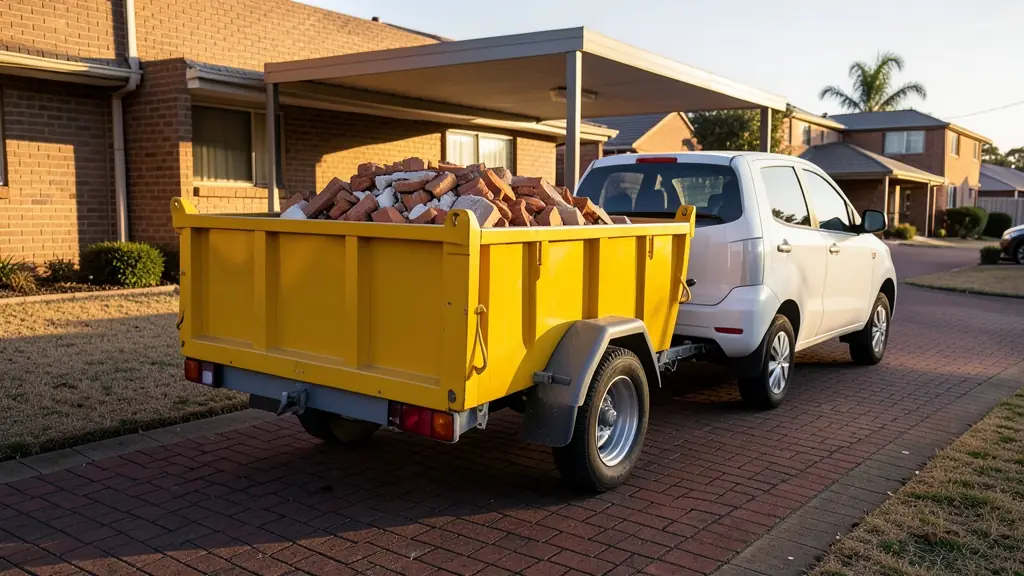
A skip that sits on its own wheels changes the job in two ways. It can be parked where a skip loader truck could never reach, under a carport or at the end of a narrow panhandle driveway, and it can be moved again when the gate has to open. Trailer skip bins come two ways: dropped off and towed away by the operator, or hired for you to pull behind your own bakkie. That second option sounds simple and cheap, and sometimes it is. This page covers who tows, what the weight does, tipping, and hiring against buying.
Who tows it: the operator or your bakkie
With the drop-off kind, the operator brings the trailer skip, unhitches it where you point, and fetches it full on an agreed day. You never touch a tow bar. It suits a homeowner in a complex who wants something tidier than a mini skip on the paving and a driver who can reverse into a tight spot.
With waste trailer hire, you collect the trailer, fill it and tow it to a drop-off or landfill yourself. You save the delivery and collection trips, but you take on the driving, the queue at the gate and the tipping fee. Price both ways with the removal cost calculator.
Weight on a tow bar is not weight in a skip
A trailer skip full of broken concrete is a heavy thing to have behind a bakkie on a hill. Before you hire one to tow yourself, check:
- Your bakkie's towing limit, in the owner's manual or on the vehicle, braked and unbraked.
- Your driving licence code, and whether it covers the combination once loaded. Ask the traffic department if unsure.
- The trailer's own licence disc, its brakes, lights and tyres, before you leave the yard.
- The load itself: soil, concrete and wet sand reach the weight long before the skip looks full. Run the skip size calculator first.
If this, then that
- If the driveway is too narrow or low for a skip truck, a trailer skip dropped by the operator is often the answer.
- If you own a bakkie and the drop-off is close, towing it yourself may cost least, for light loads.
- If the job is a whole house of rubble, a tipper or a full size skip will need fewer trips.
- If the rubble is inside the house and upstairs, rubble bags may be easier than any skip.
Tipping a trailer skip at the drop-off
- Check the municipality's list of drop-offs and what each takes from residents with trailers.
- Keep clean rubble apart from garden refuse and general waste; many sites want them in different places.
- Ask the hire yard how the skip tips: a hydraulic tipping trailer, a manual tilt, or lifted off by a truck.
- Strap a net or tarpaulin over the load so nothing blows off on the road.
- Keep the weighbridge ticket or gate slip.
What to put in your request
- Dropped and fetched, or towed by you
- Your bakkie and whether it has a tow bar
- The material: clean rubble, garden or mixed
- Driveway width, slope and carport height
- How many days you need it on the stand
Trailer Skip Bins for homes, builders, sites, complexes and farms
- Homeowners: a trailer skip under the carport while the old patio and braai are broken out
- Builders and renovators: a small bin towed between two bathroom jobs in the same suburb in one week
- Developers and main contractors: a towed bin for snag list rubbish on finished units after the big skips leave
- Complexes, estates and landlords: a trailer skip that fits the complex's narrow roads and moves for residents' cars
- Shops, offices and schools: a towed bin behind the shop for a weekend fit-out, gone before trading on Monday
- Factories, warehouses and mines: a trailer skip pulled around the yard for offcuts and sweepings, then tipped
- Municipalities, churches and NGOs: trailer skips towed between plots on a community clean-up day, one street at a time
- Farms and smallholdings: an owned trailer skip towed behind the bakkie to clear old sheds and the farm dump