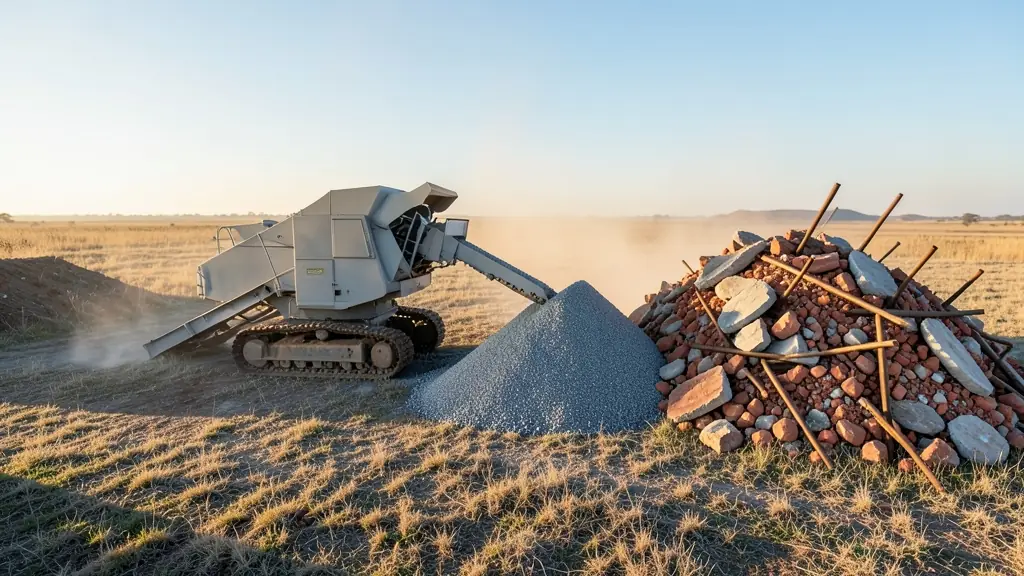
Broken concrete and brick do not have to be buried. Put through a crusher, clean rubble becomes recycled aggregate that can go back under a road, a slab or a paved yard, and the steel inside it goes to the scrap dealer. Recycling builders' rubble works only when the material arriving at the crusher is clean, and that is decided long before the truck leaves your site. This page covers what a crusher yard accepts, what crushed concrete is good for, when crushing on site makes sense, and how to compare it with the landfill.
What a crusher takes, and what gets a load turned away
Crusher yards want material that breaks into hard, clean stone. Each yard sets its own rules, so ask, but the pattern is usually the same:
- Usually welcome: concrete, including slabs with reinforcing, brick and block, paving, kerbs and natural stone.
- Usually refused or charged extra: soil and clay, timber, plastic, roof sheets, ceiling boards and other gypsum, bitumen, glass, and anything that might be asbestos.
A load with a few planks and a bag of plaster in it can be refused at the gate and sent on to the landfill at your cost. Keep a separate heap or skip for clean rubble from day one, as building rubble removal explains.
Where recycled aggregate ends up
- Fill under slabs, patios and driveways, compacted in layers.
- Sub base for farm roads, yards and parking areas.
- Drainage layers behind retaining walls and in French drains.
- Paths, temporary site roads and hardstand for plant and containers.
Whether crushed concrete is acceptable in a structural layer is the engineer's call, not the supplier's. Ask the engineer before it goes under a building or a public road. For getting the slabs out in the first place, see concrete removal.
Crushing on site on a big job
On a large demolition or earthworks job, a mobile crusher can come to the rubble instead of the rubble going to the crusher. The broken structure is crushed where it lies and laid back as a working platform or fill, which saves many truck trips to the landfill and many more bringing in new stone.
It needs room for the crusher, the feed heap and the product heap, a machine to feed it, and a site far enough from neighbours, or screened well enough, for the dust and noise. Ask the municipality about any approvals, and ask the demolition contractor whether they offer it.
Comparing a crusher yard with the landfill
- Work out the tonnes, not just the cubes, with the rubble volume calculator.
- Get the landfill cost for that weight from the landfill fee calculator.
- Ask the nearest crusher yards what they charge, or pay, for clean concrete and brick.
- Add the haul to each; a cheaper yard far away can cost more in trips.
- Count the aggregate you would otherwise buy for fill.
What to put in your request
- What the rubble is: concrete, brick or both
- How clean it is, and what else is mixed in
- Whether there is steel reinforcing in it
- Rough volume, or the size of the slab or wall
- Whether you want aggregate back for fill
Rubble Recycling for homes, builders, sites, complexes and farms
- Homeowners: an old driveway or patio broken up and sent to a crusher instead of the dump
- Builders and renovators: keeping brick and concrete clean on site so the loads go to the crusher for less
- Developers and main contractors: crushing a demolished structure on site and laying it back as a working platform
- Complexes, estates and landlords: old paving and kerbs from an estate road upgrade recycled into the new sub base
- Shops, offices and schools: a parking area rebuilt with its own broken concrete crushed as the new sub base
- Factories, warehouses and mines: factory floors and hardstands broken out and crushed rather than trucked to landfill
- Municipalities, churches and NGOs: road and pavement rubble from public works recycled for fill and temporary site roads
- Farms and smallholdings: old dam walls, kraals and slabs crushed into gravel for farm roads and yards