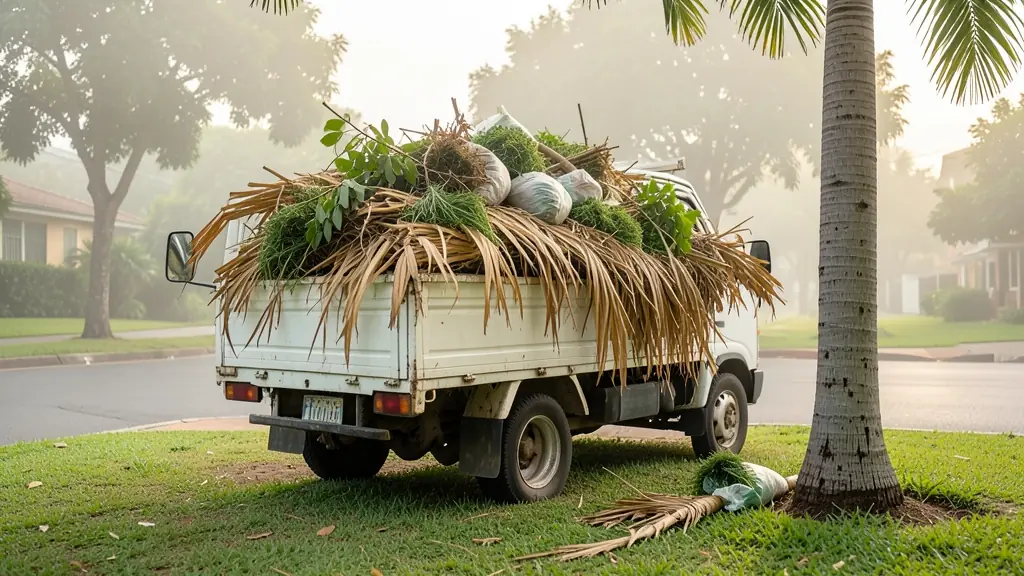
A garden heap fools people twice. It looks like a small job until you count the cubes, and it looks heavy until you lift it. Branches, palm fronds and grass take a lot of room and weigh little, so the question for garden refuse removal is space on the truck, not tonnes. What changes the price is what hides in the heap: a few bricks from the old braai, a stump with soil on its roots, a bag of paving offcuts. Keep the heap green and you keep it cheap.
What is in the heap, and how each part behaves
- Grass cuttings and leaves: light, but they compact and go wet in bags; a pile left a week in summer starts to rot.
- Branches and hedge trimmings: springy and full of air, so they fill a truck fast; cut long ones to the length of the body.
- Palm fronds: long, sharp at the base and awkward to stack; a single cut palm can fill a load on its own.
- Stumps and roots: heavy with the soil still on them, and slow to dig out without a machine.
- Soil and old lawn: this is not garden refuse any more by weight; price it as soil removal.
Bakkie, trailer, truck or a chipper on site
- If it is a few bags and a pruned hedge, a bakkie run to the municipal garden drop-off may be all you need; check the municipality's list of drop-offs first.
- If it is a season's worth of trimmings, a trailer or a team with a 6 cube truck usually does it in one visit.
- If there are big trees or a row of palms, ask about a chipper: chips take far less room than branches and can stay as mulch.
- If rubble is mixed in, keep it in its own pile, because a mixed load often cannot go to a garden site.
The garden refuse calculator turns bags and branches into cubes and loads.
When the work piles up through the year
On the Highveld the summer storms bring down branches and the grass grows faster than anyone can cut it, so teams get busy from November to March. In Cape Town the pruning and the clearing of storm damage cluster around the winter rain, and in KwaZulu-Natal the growth barely stops, which is why palms and creepers come up so often in Durban North and Umhlanga.
Book ahead in a busy month, and ask whether a team can come back on a regular round if you have a big garden or manage a complex.
Getting the garden ready for the team
- Rake loose material into one heap near the gate, not across the lawn.
- Pull out bricks, wire, plastic pots and paving from the pile.
- Cut long branches down to about the length of a bakkie.
- Leave space for the truck to stand without crossing a soft lawn or a septic tank.
- Ask whether invasive plants on the property need special handling, and check the rules with the council.
What to put in your request
- What is in the heap: grass, branches, palms
- A rough size in bags or bakkie loads
- Any stumps or soil that must go too
- How close the truck can get to the heap
- Whether you want the chips left as mulch
Garden Refuse Removal for homes, builders, sites, complexes and farms
- Homeowners: an overgrown back garden, a row of palms or the bags after a big weekend prune
- Builders and renovators: clearing shrubs and old lawn before a patio, a pool or an extension goes in
- Developers and main contractors: green waste from stripping a stand, kept apart from soil so it stays cheaper to cart
- Complexes, estates and landlords: a regular round for the complex's common gardens, verges and storm damage after summer
- Shops, offices and schools: trimming hedges and trees around a shop, school or office park before the rains
- Factories, warehouses and mines: clearing overgrown yards, fence lines and storm water channels around a factory or warehouse
- Municipalities, churches and NGOs: a community clean-up of a park or an open plot full of cut branches
- Farms and smallholdings: orchard prunings, windbreak branches and fallen gum trees near the house and the sheds