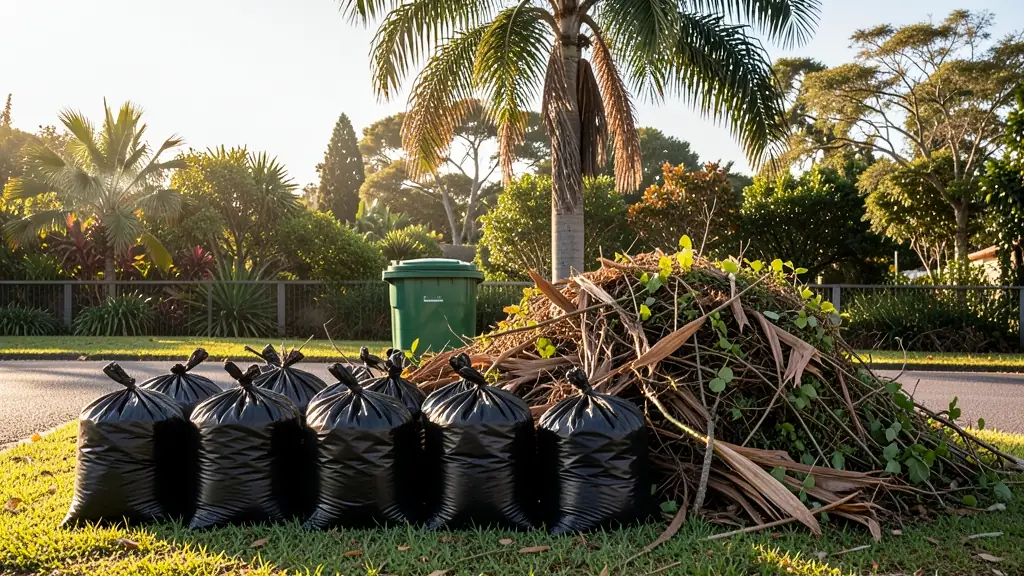
Garden refuse almost never weighs too much for a truck; it simply fills it. Count what you have: full refuse bags, wheelie bins, metres of hedge cut back hard, small trees, palms and the lawn area cut. The calculator turns it into loose cubes and shows how many level bakkie loads, small trailer loads, 6 cube truck loads or 6 cube skips it takes. Bag and bin sizes come from sellers' pages; the hedge, tree, palm and lawn figures are our defaults, which you can change. Collection is covered on garden refuse removal.
How the cubes are counted
Each item has a loose volume: an 80 litre refuse bag, a 240 litre bin, a level single cab bakkie load and a small trailer load from sellers' sizes, and our own defaults for a metre of hedge, a small tree cut up, one palm's old fronds and the cuttings from 100 m² of lawn. The total is divided by each vehicle's size.
The weight is shown too, at a published factor for uncompacted yard waste of about 0.15 tonnes a cube, so you can see it is the space, not the weight, that decides the load.
Changing the defaults to your garden
- Hedges: a tall, thick hedge cut to half its width makes far more than our 0.3 cube a metre.
- Trees: our 2 cubes is for the branches and trunk of a tree about 4 m high, not the stump or roots.
- Palms: fronds are long and stiff; cutting them shorter packs them better.
- Lawn: an overgrown lawn after the rains gives much more than a weekly cut.
If you are not sure, take photos of the heap and send them with the request.
What raises the cost of garden refuse
- Rubble mixed in: bricks, soil and stones in the heap make it builders' waste at many sites, and the cost goes up.
- Loose branches: uncut branches lock together and carry half the cubes.
- Thorny and invasive plants: some may need care to handle, and some sites keep them apart.
- Stumps: heavy and awkward; they usually need a machine or a separate price.
- Plastic bags: some sites want garden refuse loose so it can be chipped or composted.
From the count to a collection
Put the cubes and what is in the heap on the request below: branches, palm fronds, grass or a mix, and whether anything is in bags. Garden refuse teams quote per load, so tell them which vehicle the number refers to and whether they must cut and load. Many metros run garden refuse drop-offs for residents with cars and bakkies; check the municipality's list before you hire. For a whole overgrown stand, read site clearing.
Sources
- South African variety retailer, black refuse bags: 75 x 95 cm black refuse bags, sized for standard 80 litre bins
- Farming weekly, single cab bakkie test: load bin 2.2 x 1.7 x 0.405 m (about 1.5 m³), rated to carry a 1 t load; the diesel tows 1,500 kg
- United States environmental agency, volume to weight conversion factors (2016): mixed yard waste, uncompacted, 250 lb per cubic yard (about 0.15 t/m³); branches and stumps 127 lb; mixed household and commercial waste, uncompacted, 250 to 300 lb per cubic yard (0.15 to 0.18 t/m³)
- Cape Town skip hire site, mini and builder's skips: 2 m³ and 3 m³ mini skips and a 6 m³ builder's skip; fill below the rim; soil, brick and concrete loads count as heavy
Frequently asked questions
How many bags of garden refuse fit on a bakkie?
Will a skip of garden refuse be overweight?
Can I change the figure for a tree or a palm?
Who will collect it after I add it up?
More calculators and tools
- Rubble volume calculatorCubes as it lies, cubes once loaded, and the tonnes it weighs
- Skip size calculatorEvery bag, skip and truck for your load, by volume and by weight
- Demolition waste calculatorThe rubble a wall, a garage or a house leaves when it comes down
- Truck loads calculatorLoads, trips and hours to move a volume, by hand or with a TLB
- Removal cost calculatorBags, skips, a trailer and tippers priced for the same job
- Landfill fee calculatorWhat tipping a load costs at the weighbridge, and the sums