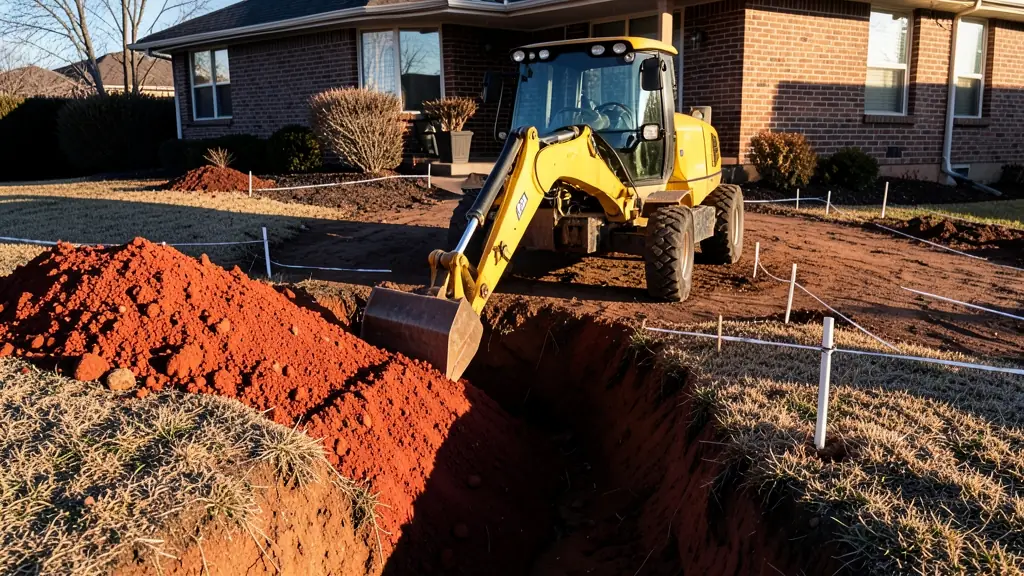
A builder in Kempton Park books a TLB for "a morning" to dig the footings for a double garage, and the invoice says five hours. Two of those were the drive from the yard and the minimum charge, one was spent waiting for the tipper. TLB hire is cheap per hour of real digging and expensive per hour of standing, so the job is in the planning. This page explains what the machine does well, how the hours are counted, what wet and dry hire mean, and the questions that keep the bill close to the quote.
Two machines on one chassis
The backhoe at the back digs: foundation trenches, pipe and cable trenches, soak pits, holes for poles and the odd stump. The bucket at the front loads, pushes and levels: it fills a tipper from a heap, spreads fill, backfills trenches and scrapes a stand flat. Many TLBs can also take a hydraulic hammer on the backhoe for breaking a slab or a footing, if the operator has one and you ask for it.
The weak spots are depth and soft ground. A deep basement or a big dam is quicker with an excavator, and a muddy site after a Highveld summer storm can bog a wheeled machine that tracks would cross.
How the hours on a TLB hire quote are counted
- The minimum: most operators charge a minimum, often a few hours or a full day, even if the job takes less.
- Travel: the TLB either drives to site, which may be charged as hours, or comes on a lowbed for a fixed fee.
- Standing time: waiting for a tipper, a delivery or a decision is usually billed.
- Per day: a day rate normally means a set number of hours; ask how many and what overtime costs.
Work out the loads before you book with the truck loads calculator, which also estimates loading time with a TLB.
Wet hire, dry hire and the operator
Wet hire includes the operator and the diesel, and is what most homeowners and small builders want. Dry hire is the machine alone, for a contractor with a competent, authorised operator of their own and insurance that covers it. Ask what happens if a dry hire machine is damaged on your site.
A good operator is worth more than a cheaper machine. Ask how long they have run a TLB and whether they have dug in suburbs before, where every metre has a pipe or a cable under it.
Before the bucket goes in
- Find the water, sewer and electricity lines, and ask the municipality or a locator about services in the road reserve.
- Mark the trench lines with paint or string, and the depth with the engineer's drawing.
- Clear a place for the spoil and a way in for the tipper.
- Agree in writing who pays for a broken pipe or cable.
- Have the tipper booked for when the TLB starts loading, not after.
What to put in your request
- What it must dig, load or level, and how much
- Gate width, carport height and slope of the stand
- Wet hire with an operator or dry hire
- Whether you need a hammer for concrete
- Whether a tipper must be booked as well
TLB Hire for homes, builders, sites, complexes and farms
- Homeowners: footings for a garage or a granny flat, a pool hole, or levelling a sloped garden
- Builders and renovators: foundation trenches for extensions, backfilling after the plumber, and loading the rubble tipper
- Developers and main contractors: service trenches, bulk loading of tippers and backfill on a phased housing site
- Complexes, estates and landlords: a burst pipe dug up in the complex, new paving bases and stormwater trenches
- Shops, offices and schools: a new parking area base, a soak pit or trenches for a cable to the outbuilding
- Factories, warehouses and mines: breaking a yard slab with a hammer, trenching for services and loading spoil
- Municipalities, churches and NGOs: clearing an illegal dumping plot, trenching on a school site and loading waste
- Farms and smallholdings: a water pipe trench to the kraal, cleaning a furrow and loading old building rubble