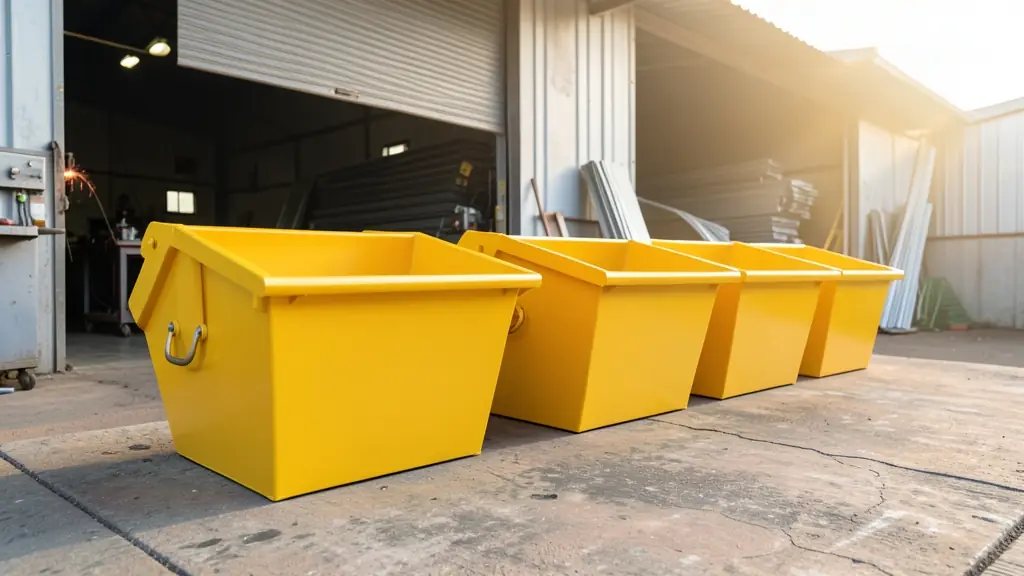
Someone in Vereeniging with one skip loader truck and a plan, a farm in the Free State that wants its own bins in the yard, a factory tired of hiring the same skip every week, a municipality replacing rusted bins at its drop-offs: they all end up comparing skip bins for sale. A bin is a box of steel that lives a hard life of lifts, drops, concrete and rain. What separates a bin that lasts many years from one that splits at the seams is the steel, the welding, the lugs and the paint. Here is what to look at.
Who buys skips, and why it changes the order
A new skip business needs a set of bins in a few sizes that all suit one truck, because a mixed fleet with different lugs is a daily headache. A farm or a factory may only need two or three bins that stay on site and are emptied by a contractor, so the lugs must suit that contractor's truck.
A municipality or a large estate often buys by tender, with a written specification. In each case, decide first who will lift the bins, then order the sizes around that.
The steel, the seams and the lugs
- Steel thickness: ask for the gauge of the floor and the sides separately; the floor takes the worst of broken concrete.
- Welds: look for continuous seams, not stitch welds, where the floor meets the sides.
- Top rail and stiffeners: a reinforced rim and ribs stop the sides bowing out under heavy loads.
- Lugs: the size, height and spacing must match your loader truck's chains or arms. Take the truck's measurements to the manufacturer.
- Paint: ask about the primer and the coats; bare steel rusts fast near the coast.
Buying second hand bins
- Look at the floor from inside and underneath for thin spots and holes.
- Check each lug for cracks in the weld and for bent pins.
- Look along the sides for bulges that show past overloading.
- Ask whether a door, if it has one, still closes and latches.
- Price the repairs and paint before you agree a figure.
A cheap bin that needs a new floor is not cheap. Trailer skip bins for sale are covered on trailer skip bins.
The skip bins truck and running the bins
A skip bins truck for sale is a bigger purchase than the bins, and the two must work together: the loader's lifting capacity, the chain or arm type and the bed length decide which bins it can carry. Ask a mechanic to check the hydraulics, and check the licence and roadworthy questions with your local testing station.
Running bins also means knowing the landfills near you; see dumping sites and the landfill fee calculator.
What to put in your request
- How many bins, and in which sizes
- New or second hand
- Your loader truck and its lug spacing
- Doors, lids or reinforced floors needed
- Delivery to your yard and the paint colour
Skip Bins for Sale for homes, builders, sites, complexes and farms
- Homeowners: rarely a home buy, but some owners of big properties keep one bin on site
- Builders and renovators: a builder buying a few bins and having them emptied rather than hiring each week
- Developers and main contractors: bins bought for a long project and moved from one site to the next
- Complexes, estates and landlords: an estate buying bins for its garden and builders' waste yard
- Shops, offices and schools: a starting skip business pricing its first set of bins and a truck
- Factories, warehouses and mines: a factory buying its own bins for offcuts, rubble and general waste
- Municipalities, churches and NGOs: a municipality replacing rusted bins at drop-offs and depots by tender
- Farms and smallholdings: a farm keeping its own bins in the yard for old buildings and the farm dump