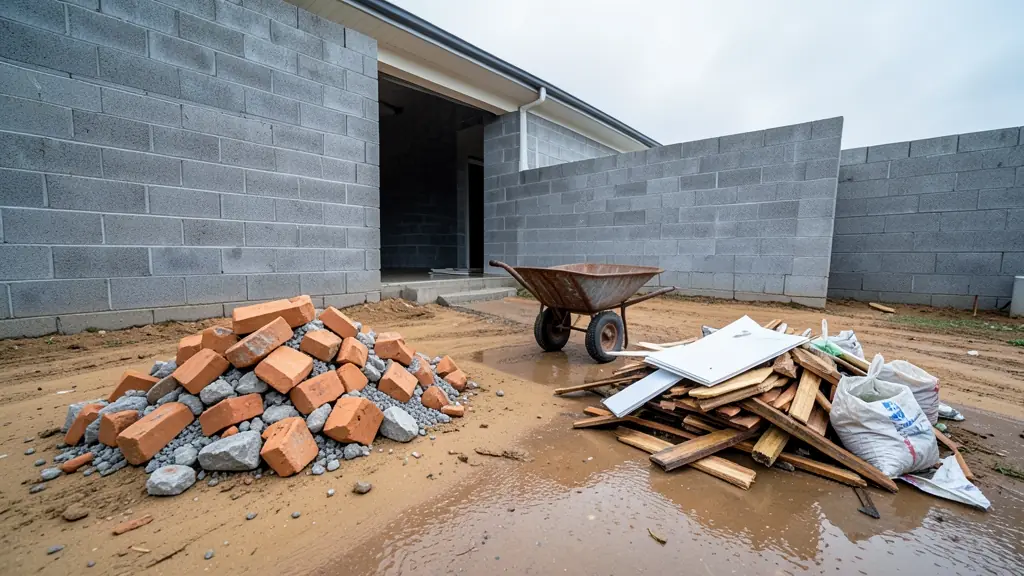
Walk round any extension or renovation at the end of a week and the rubble pile tells its own story: half bricks and mortar, a broken lintel, tile offcuts, then cement bags, a roll of DPC, pine offcuts and a cracked ceiling board on top. That last layer is what drives the price up. A heap of only brick, block, concrete and stone is clean rubble, cheaper to tip and fit for crushing. Mix in the light stuff and it becomes general waste. A builder who keeps the two apart pays less to get rid of the same job.
What really ends up in builders' rubble
On a typical South African building job the heavy part is brick, block, plaster, screed, concrete, tiles and the sand that spills everywhere. That is mostly inert waste, and a crusher yard or a landfill treats it as the simple kind.
The trouble is the rest: timber, gypsum ceiling boards, roof sheets, plastic wrap, polystyrene, paint tins and the odd garden refuse bag. Some of it, like paint and solvents, does not belong in a rubble load at all and needs the hazardous waste route.
A simple sorting routine for a small site
- Pick two spots on day one, close to where the truck or skip will stand: one for clean rubble, one for everything else.
- Tell the team which is which, and put a sheet of board or an old door down so the heaps do not spread.
- Keep metal offcuts and old burglar bars aside, someone will collect them.
- Bag the plastic and packaging as you go, so wind does not take it into the neighbour's yard.
- Book the clean rubble load when the heap is a full load, not before.
Keeping the site tidy while the job runs
A body corporate, a neighbour or a building inspector forms an opinion of your work from the pavement. Rubble on the verge, a skip with ceiling boards sticking out and sand in the gutter all invite complaints, and municipal by-laws deal with builders' rubble left in the road reserve. Use the demolition waste calculator to plan the loads from a strip-out, so you book collections in step with the work rather than after the pile has taken over the driveway.
Building rubble dump sites near me: what builders should know
Many metro drop-offs take small loads of builders' rubble from residents in cars and bakkies, but trucks and contractors are usually sent to the landfill and pay at the weighbridge. Check the municipality's list before you load. The dumping sites page explains the difference, and the landfill fee calculator shows how a tipping fee is worked out.
What to put in your request
- Clean brick and concrete, or mixed with timber
- How the rubble came about: extension, strip-out
- Where the heap is and how close a truck gets
- Whether it is one load or a schedule of loads
- Any old roof sheets you are unsure about
Building Rubble Removal for homes, builders, sites, complexes and farms
- Homeowners: the rubble an extension leaves, sorted so the clean heap tips cheaper
- Builders and renovators: two heaps on site from day one, clean rubble and the rest
- Developers and main contractors: sorting bays per phase so clean loads go to the crusher, not landfill
- Complexes, estates and landlords: unit contractors made to keep rubble off the common driveway and verge
- Shops, offices and schools: a refit's brick and screed kept apart from shopfitting boards and packaging
- Factories, warehouses and mines: plinths and block walls removed during an upgrade, carted as clean rubble
- Municipalities, churches and NGOs: school or clinic building works with rubble records kept for the tender
- Farms and smallholdings: old outbuilding bricks stacked for reuse and the broken ones carted