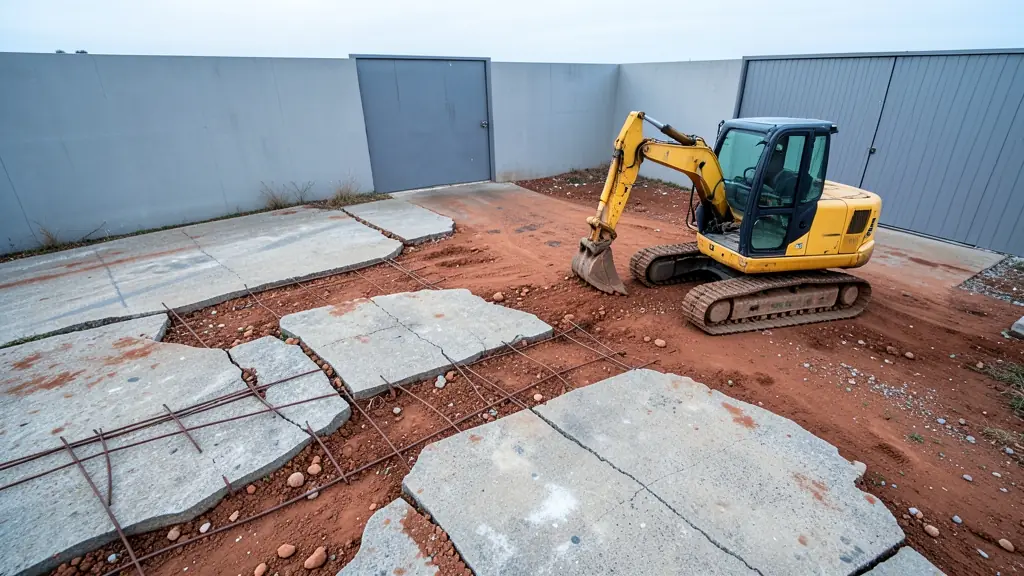
Concrete fools people because it does not look like much. A driveway slab broken into pieces makes a modest heap, yet that heap can outweigh a whole skip of renovation waste. Before anything is carted it must be broken into pieces that can be lifted, the steel mesh or bars inside dealt with, and a truck or skip chosen for its weight limit rather than its size. Get that right and clean concrete is one of the easier materials to get rid of, because a crusher yard may take it as raw material rather than waste.
Breaking it: by hand, by machine, or both
A thin path or a shower base can come out with a jackhammer and a crowbar in a day. A driveway, a garage floor or a set of old footings usually needs a breaker on a mini excavator or a hammer attachment on a TLB, followed by the bucket to load.
Before anyone breaks, find out what runs underneath. Water pipes, sewer lines and electrical cables often sit right under an old slab. Ask the plant operator who pays if a service is damaged.
The steel inside the slab
Most slabs, footings and reservoir walls carry mesh or bars. Some crusher yards want the steel cut flush, some take it in, and a scrap dealer may collect long lengths separately. Ask the operator whether cutting the steel is in the price, because a team with an angle grinder adds hours to the job. Pieces sized to fit the truck or skip also load faster and stack better.
Weight before volume: four checks
- Measure the slab and its thickness and run the rubble volume calculator for concrete.
- Put that into the skip size calculator; concrete often fills a skip by weight long before it reaches the top.
- Tell the skip company the load is concrete. A skip for concrete may be a smaller bin, with a fill line, so the loader truck can lift it.
- For a big slab, compare a tipper loaded by machine; see tipper truck hire.
Where broken concrete can go
Clean concrete, without soil, timber, plastic or brick mixed in, is wanted by some crusher yards and private sites, which crush it into aggregate for fill and sub base. A load that is mixed goes to a landfill instead and usually costs more. The rubble recycling page explains what crushers accept; check the municipality's list for landfills that take concrete.
What to put in your request
- The slab's area and thickness
- Already broken, or still to be broken
- Mesh or bars inside, and roughly how much
- What may run underneath the slab
- How close a skip or tipper can get
Concrete Removal for homes, builders, sites, complexes and farms
- Homeowners: an old driveway, a cracked patio or a garage floor broken and carted
- Builders and renovators: footings and screed broken out for an extension, loaded with the bucket
- Developers and main contractors: old slabs and foundations cleared from a stand before new work starts
- Complexes, estates and landlords: a common area slab or old pool shell removed within the estate's hours
- Shops, offices and schools: a shop floor screed broken out for new services, carted at night
- Factories, warehouses and mines: machine plinths and worn hardstand broken out, with the steel recovered
- Municipalities, churches and NGOs: kerbs, old paths and slabs removed from a school or clinic site
- Farms and smallholdings: an old reservoir or dairy floor broken up and reused on farm roads