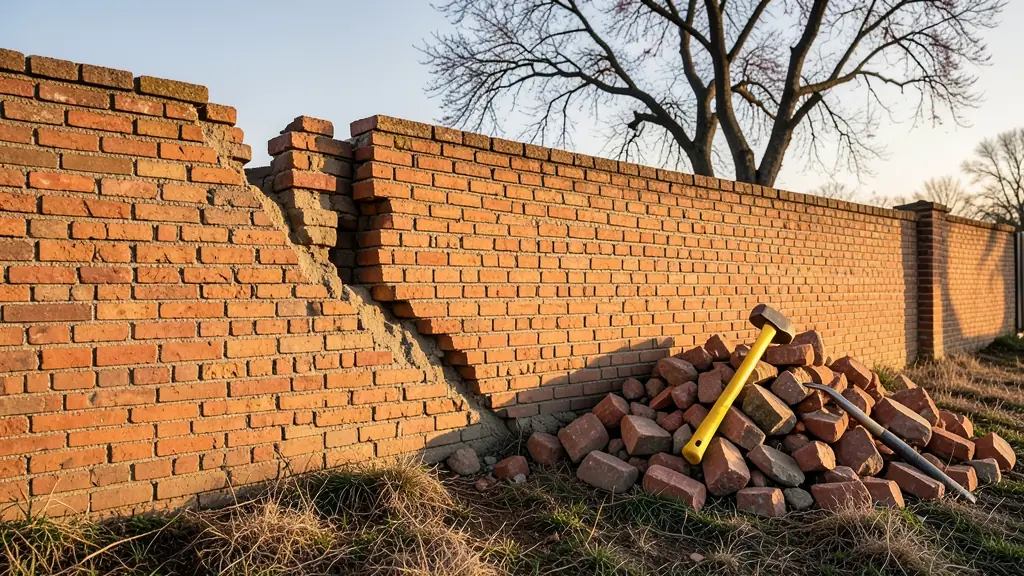
Demolition quotes are about the carting as much as the breaking: a small brick house can leave a hundred tonnes or more once the slab and footings are counted. Use the wall mode for a boundary wall, a garden wall or an internal wall, with its type, length, height and the openings to take off. Use the building mode for a house, a double storey, a garage, a shed or a commercial building by its floor area. You get tonnes, loose cubes and truck loads. Permits and the order of work are on demolition contractors.
Walls and buildings, worked out differently
A wall: length times height, less doors and windows, times the thickness and the share that is solid, gives the cubes of masonry. Hollow concrete blocks are only about half solid, which a South African masonry manual sets out. The density turns it into tonnes and the swell factor into loose cubes.
A building: the floor area times a rate in tonnes per m². Published rates are from studies abroad, so for South African brick houses we did our own takeoff of the slab, footings, walls and roof and checked it against them. The note under each rate says how.
What the rates include and leave out
- Included: walls, slab on the ground, strip footings, foundation walls, a concrete first floor where there is one, roof tiles or sheets.
- Left out: paving, driveways, boundary walls, pools and outbuildings. Add them with the wall mode or the rubble volume calculator.
- Not rubble: roof timber, steel, doors, windows and fittings usually come out in the soft strip and are sold or carted separately.
Change the rate if your contractor has weighed the rubble from similar buildings.
Before anyone swings a hammer
- Asbestos: many roofs, gutters and ceilings on buildings from before about 1990 are asbestos cement. A registered asbestos contractor must remove it first; it never goes in the rubble.
- Permits: ask the municipality whether you need a demolition permit.
- Services: electricity, water, gas and sewer must be cut off and made safe.
- Neighbours: a shared boundary wall is not yours alone to take down.
- The engineer: walls that carry a roof or a slab need advice before they go.
Using the tonnes in a demolition quote
Send the building type, the floor area or the wall sizes, and the tonnes from here with the request below. Demolition contractors price the breaking, the sorting and the carting; with the tonnes in hand you can see whether a quote allows for enough truck loads. Ask whether the price includes the slab and footings, what they salvage and credit, where the rubble goes, and whether you get weighbridge slips. Clean concrete and brick can often go to a crusher, which the rubble recycling page explains.
Sources
- South African concrete masonry manual, solid and hollow units: a solid unit has cavities of not more than 25% of its gross volume, a hollow unit 25% to 60%; two core hollow units: 390 x 140 x 190 mm 52% solid, 390 x 190 x 190 mm 53% solid
- Waste management journal, construction and demolition waste indicators (2013): survey of international studies; concrete waste alone from buildings with a reinforced concrete structure: residential demolition 492 to 840 kg/m², non-residential demolition 401 to 768 kg/m²
- Thai university study, waste from a single family house (2024): a concrete and masonry single family house: demolition 1,563.86 kg/m², renovation 133.11 kg/m², construction 83.41 kg/m²
- United States environmental agency, building related demolition debris (1998): single family house demolition 111 lb/ft² (about 540 kg/m²), of which concrete 61 lb/ft²; multi-family 127 lb/ft²; non-residential demolition 155 lb/ft² (about 760 kg/m²) from 23 buildings
- Civil engineering reference, unit weights of construction materials: brick masonry 1,920 kg/m³; plain concrete 2,300 and reinforced 2,400 kg/m³; dry sand 1,540 to 1,600, wet sand 1,760 to 2,000; clay 1,440 dry to 1,760 damp; earth 1,410 to 1,840 dry and 1,600 to 2,000 moist
- Structural design site, unit weights to the European loading standard: to EN 1991-1-1: plain concrete 24.0 and reinforced 25.0 kN/m³; asphaltic concrete 24 to 25, hot rolled asphalt 23 kN/m³; dry sand 15 to 16 kN/m³; 37 mm screed 0.8 kN/m²
- Excavation calculator site, compiled swell and bulking factors: from road agency and textbook tables: concrete pavement 67%, brick pavement 67%, masonry rubble 67%, asphalt pavement 50%; clay 18 to 50%, sand 5 to 15%, gravel 5 to 33%, topsoil 25 to 56%
Frequently asked questions
How many tonnes of rubble does a house make?
Why is a garage heavier per m² than a house?
Do hollow block walls make less rubble than brick?
Can I get demolition quotes through this page?
More calculators and tools
- Rubble volume calculatorCubes as it lies, cubes once loaded, and the tonnes it weighs
- Skip size calculatorEvery bag, skip and truck for your load, by volume and by weight
- Truck loads calculatorLoads, trips and hours to move a volume, by hand or with a TLB
- Removal cost calculatorBags, skips, a trailer and tippers priced for the same job
- Garden refuse calculatorBags, branches, palms and lawn cuttings in cubes and loads
- Landfill fee calculatorWhat tipping a load costs at the weighbridge, and the sums