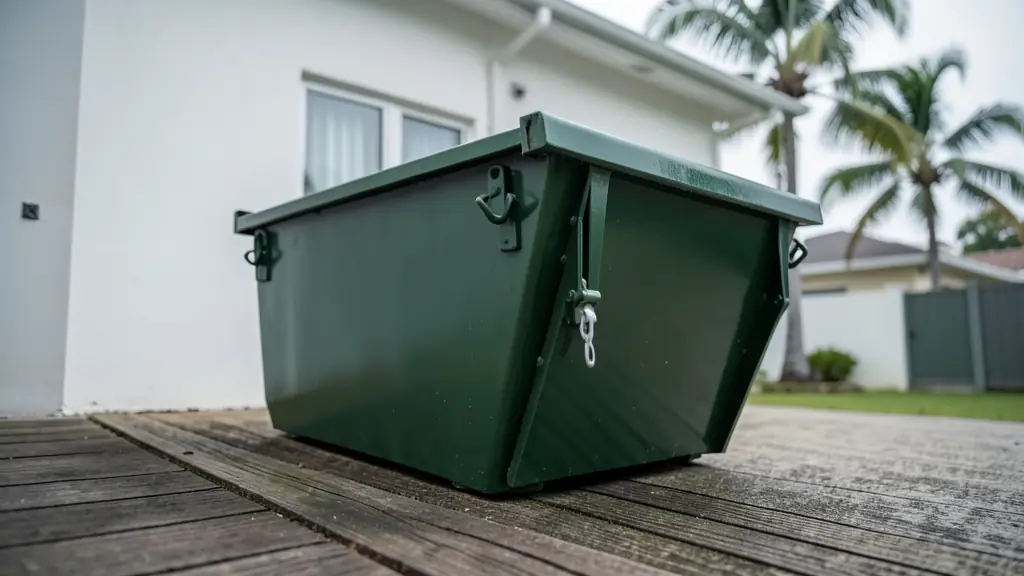
Most people only meet a skip bin when one is dropped outside their gate, yet the shape of the thing explains a lot about how to use it. The sloped sides, the four heavy lugs, the door some bins have at one end and the boards under it are all there for a reason. Knowing them helps you ask for the right waste skip bin, place it where the loader truck can lift it cleanly, fill it so it rides safely on the road, and keep your paving in one piece. This page is about the bin itself.
Why every skip bin is narrower at the bottom
The taper is not for looks. Narrow at the base and wider at the rim, empty bins nest inside each other, so a yard can stack them and a truck can carry more than one back to the depot. The slope also helps the load slide out when the bin is tipped at the landfill.
The lugs on each end take the chains or arms of the skip loader truck. The truck backs up square to the bin, hooks on and swings it up onto its bed, which is why the driver needs a straight run in and room overhead to lift.
Doors, lids and covers
- Drop-down door: some rubbish skip bins have a hinged door at one end, so you can walk a wheelbarrow in and stack the heavy pieces at the back. Close and latch it before collection.
- Lids: a lockable lid keeps neighbours from adding their own waste overnight and keeps Cape winter rain off light loads.
- Net or tarpaulin: a cover over loose waste stops it blowing out on the road; many operators expect one on a full bin.
Ask which of these the company has; not every fleet does.
Sizes and shapes to ask about
Bins range from small ones for a garage clear-out to large open bins on building sites, and some yards also run low, long bins for heavy rubble. Ask for the volume in cubic metres, not a nickname, and say what goes in. A low bin often suits concrete and soil, because the weight limit is reached before the volume.
The skip size calculator compares sizes by both measures, and the mini skip hire page covers the smallest bins.
Placing the bin without cracking the paving
If this, then that:
- Clay pavers or thin concrete: ask for boards or planks under the bin, and keep the truck's wheels off weak edges.
- A lawn after Highveld summer storms: expect the truck to sink; put the bin on the driveway instead.
- A slope: the bin may slide when full, so place it on the flattest spot.
- The verge: check with the municipality first, and keep the pavement open.
For the full hire process, see skip hire.
What to put in your request
- The volume you need, in cubic metres
- What goes in: rubble, soil, timber or mixed
- Whether you want a door or a lockable lid
- The surface it will stand on
- Any low wires, gates or trees on the way in
Skip Bins for homes, builders, sites, complexes and farms
- Homeowners: a lidded bin on the driveway so neighbours do not fill it overnight
- Builders and renovators: a bin with a door so the crew wheelbarrows rubble straight in
- Developers and main contractors: large open bins on a hardstand, placed where loader trucks turn easily
- Complexes, estates and landlords: a small bin on boards in a visitor bay the body corporate approves
- Shops, offices and schools: a covered bin in a loading bay behind a shop or a restaurant
- Factories, warehouses and mines: low bins for heavy slab and plinth rubble on a factory hardstand
- Municipalities, churches and NGOs: several open bins at a community clean-up of an open plot
- Farms and smallholdings: a bin parked in the yard on firm ground clear of the wet lands