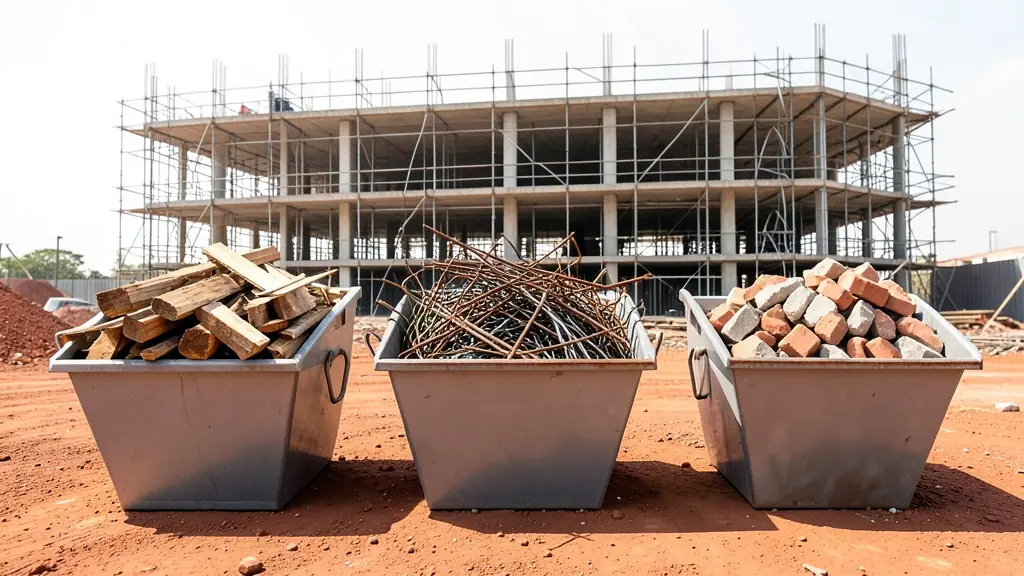
Most sites manage waste by accident: one big skip at the gate, filled with whatever is nearest, emptied when it overflows. A deliberate approach costs a little thought at the start and pays back in lower disposal bills, a tidier and safer site, and records that a client, a green building assessor or a tender panel can check. Construction waste management comes down to four things: knowing roughly what waste the job will make, sorting it where it falls, getting each stream to the right place, and keeping proof. Here is a simple site waste plan.
A site waste plan in five steps
- Estimate. List the phases (demolition, earthworks, structure, finishes) and the waste each makes. The demolition waste calculator covers what comes down; the rubble volume calculator covers excavations and heaps.
- Choose the streams. Usually clean rubble, soil, timber, metal and general waste, with hazardous waste kept well apart.
- Find the outlets. A crusher yard, a scrap dealer, someone who reuses timber, a licensed landfill and a hazardous waste handler.
- Name a person. One person on site owns the plan, books the collections and files the tickets.
- Review monthly. Compare what left site with the estimate, and adjust the bins and collections.
Sorting bays the crew will actually use
Sorting fails when it is inconvenient. Put the bays or skips where the waste is made, not at the far gate, and mark them with pictures as well as words, because crews change. Keep the clean rubble bay closest to where brickwork and concrete are cut or broken, and the timber skip near the shuttering.
On a tight stand, separate skips may not fit. Bulk bags for metal and timber, with one rubble skip swapped often, can do the job. A mesh fence around the bays stops passers-by from adding their own rubbish. See skip bins for bin types and placement.
Records worth keeping
- Weighbridge tickets or disposal slips for every load, with date, vehicle, material and site.
- Invoices from each operator, tied to those loads.
- Receipts from crusher yards and scrap dealers for material sent for recycling or reuse.
- Safe disposal certificates for any hazardous waste, from a licensed handler (see hazardous waste removal).
- A running total in tonnes per stream, the figure a green building rating or a client report usually asks for.
Where site waste plans go wrong
- Mixed skips at the crusher: a bay without a clear owner turns into general waste.
- No tickets at the end: nobody asked the operator for them, so there is no proof of diversion.
- Overweight skips: soil and concrete went into a bin sized for volume. Check with the skip size calculator.
- Rubble on the verge: a cheap carter took the load, and the dumped waste is traced back to the site.
What to put in your request
- The project, its phases and how long it runs
- Which streams you want kept apart
- Space on site for bins or bays
- How often each stream needs collecting
- The records or reports the client wants
Construction Waste Management for homes, builders, sites, complexes and farms
- Homeowners: an owner builder keeping rubble, timber and metal apart to cut the disposal bill
- Builders and renovators: a sorting corner and a ticket file on every house, extension and alteration
- Developers and main contractors: a written site waste plan with diversion records for the client, funder or rating
- Complexes, estates and landlords: estate rules on where waste stands and how each builder on the stands removes it
- Shops, offices and schools: a fit-out that must report waste figures to a landlord with green building goals
- Factories, warehouses and mines: a plant upgrade separating hazardous residues from rubble, steel and general waste
- Municipalities, churches and NGOs: tender conditions that ask for a waste plan and proof of disposal on public works
- Farms and smallholdings: a new packshed or dairy built with rubble crushed for roads and timber reused