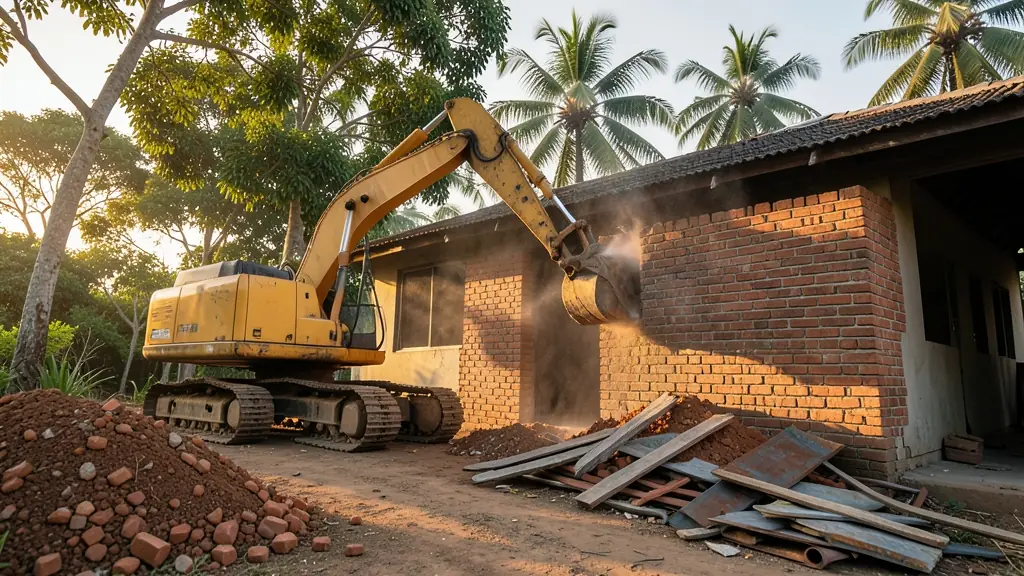
Knocking a building down takes a morning; getting ready to knock it down takes weeks. A good demolition contractor spends most of the job on things you never see in the videos: confirming the permit, getting the electricity, water, gas and sewer disconnected, finding and removing asbestos, stripping the roof and fittings, and protecting the neighbour's wall. Then the structure comes down. Whether it is a boundary wall in Pretoria, a sandstone shed near Bethlehem, the demolition of a house in Durban North or a factory in Germiston, the order is the same.
Before the first brick moves
- Ask the municipality whether you need a demolition permit, and allow time for it.
- Have the electricity, water, gas and sewer disconnected and capped by the supplier or a registered electrician and plumber, with proof.
- Check for asbestos roof sheets, ceilings, gutters and pipes. If it is there, a registered asbestos contractor must remove it first (see asbestos removal).
- Photograph the neighbours' walls and buildings, and tell the neighbours when work starts.
- Put up hoarding or fencing, and agree the truck route and the loading area.
Machine or by hand: what the building decides
A free standing house on a big erf usually comes down fastest with an excavator and a grab, loading tippers as it goes (see excavator hire). Close to a boundary, a shared wall or a building that must stay, contractors often take the last metres down by hand with breakers and hammers, so nothing falls the wrong way.
Multi storey buildings, basements and anything structurally unusual need an engineer's input on the sequence. Ask each contractor how they plan to take your building down, and why. A good answer names the machines, the order, and how they will control dust and noise.
Soft strip and salvage
- Doors, windows and frames: often sold or reused.
- Roof sheets and timber trusses: taken off before the walls and kept out of the rubble.
- Face brick and old sandstone: cleaned and stacked for reuse or resale, if you ask for it.
- Steel, copper and old geysers: to the scrap dealer.
- Clean brick and concrete: to a crusher; see rubble recycling.
Agree in writing who keeps the salvage. It can lower your price, or it may already be part of how the contractor priced the job.
Demolition costs per m²: what moves the figure
Contractors often price per m² of floor area or per job, and the rate swings with:
- the structure: brick, concrete frame, steel or timber, one storey or more
- asbestos or other hazardous material found
- access for machines and trucks, and how close the neighbours are
- the volume and weight of rubble, and the distance to the landfill or crusher
- whether foundations and slabs come out or stay
The demolition waste calculator shows how much rubble your building leaves.
What to put in your request
- What comes down and its rough floor area
- What it is built of, and how many storeys
- Whether you suspect asbestos anywhere
- Access, boundaries and the neighbours
- Foundations out or left, and salvage wishes
Demolition Contractors for homes, builders, sites, complexes and farms
- Homeowners: an old garage, outbuilding or boundary wall taken down and the stand left clean
- Builders and renovators: a partial demolition for an extension, with the rest of the house left standing
- Developers and main contractors: houses on an assembled site demolished and cleared ahead of the new development
- Complexes, estates and landlords: a clubhouse or unit block demolished inside an estate with strict hours and dust rules
- Shops, offices and schools: an old shopfront or office building demolished ahead of a rebuild on the stand
- Factories, warehouses and mines: a factory, plant room or hardstand stripped, demolished and carted, hazards removed first
- Municipalities, churches and NGOs: unsafe or derelict public buildings demolished under a municipal or provincial contract
- Farms and smallholdings: an old sandstone shed, dairy or cottage taken down with the stone saved for reuse