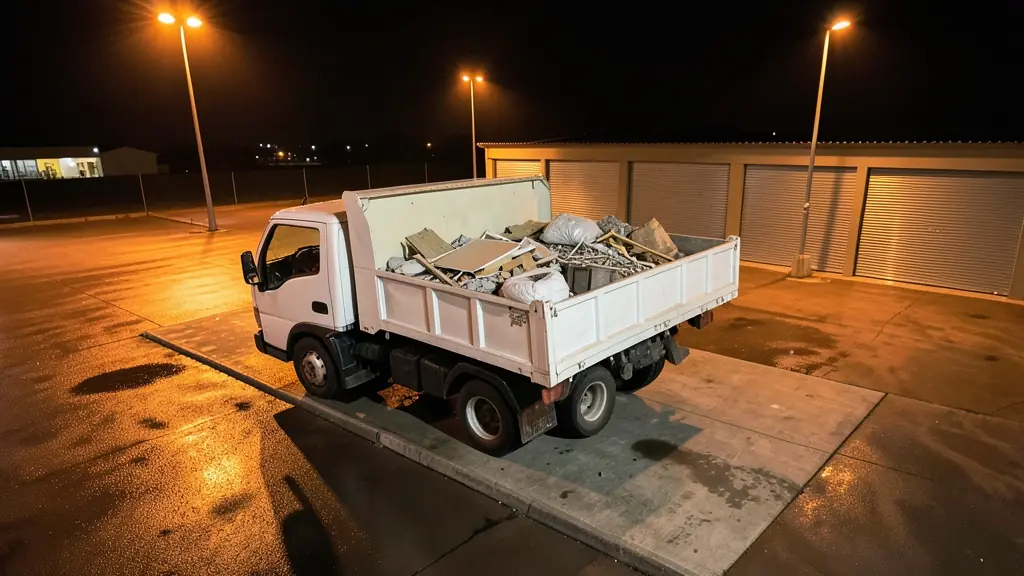
On a commercial job the rubble is rarely the hard part. The hard part is the shopping centre that lets trucks into the service yard only after the shops close, the office tower that wants every contractor inducted before they set foot in the basement, and the client's quantity surveyor who will not pay the last claim without disposal records. Commercial rubble removal is about fitting the waste into a programme and a paper trail. This page is for site managers, shopfitters and maintenance contractors who need an operator that arrives when booked and leaves the right documents behind.
What a site manager should expect from the operator
- A named contact who answers the phone on the day.
- Collections booked against the programme: daily, weekly, or when a skip reaches the fill line.
- Drivers and loaders who arrive in PPE and will sit through the site induction.
- Swap-outs, so a full skip is replaced by an empty one in the same trip.
- One invoice a month that ties each load to a date, a site and a disposal slip.
On bigger jobs, ask about sorting on site with separate bins for timber, metal and rubble.
Loading after hours in centres, towers and hospitals
Retail centres, office parks and hospitals often keep trucks out of public areas while they trade. That usually means loading between closing and opening, from a service yard or a basement with a low height limit that rules out a tipper with its body up. Give the clearance height in the request, and ask whether the operator has a smaller truck, a trailer skip or bulk bags that can be wheeled out on a pallet jack.
Night work costs more, and noise rules still apply next to homes and flats. If the centre allows it, a skip in the yard filled during the day and swapped at night can be cheaper than a full night crew. The truck loads calculator shows how many trips fit in the window.
Paperwork the client and the principal contractor ask for
- The safety file: the documents the principal contractor lists for subcontractors, which often include proof of injury on duty cover, a risk assessment and driver licences.
- Disposal slips or weighbridge tickets for every load, from a licensed site, so the waste can be traced to its legal end.
- A tax invoice with VAT, the site name and the order number.
- Diversion records if the project targets a green building rating; rubble recycling explains what a crusher yard can take.
Per load or on contract: if this, then that
- If the job runs a few weeks and the waste comes in bursts, book per load or per skip as you need them.
- If the site makes waste every week for months, ask for a contract with fixed collection days and an agreed rate per load.
- If several of your sites run at once, one operator who covers all of them simplifies the paperwork.
- If one rate is far below the others, ask where the loads go; dumped waste can be traced back to the site and the contractor. Compare like with like on tipper truck hire.
What to put in your request
- The site, its access and any height limit
- The hours trucks are allowed on site
- How often you need a collection
- Documents needed for the safety file
- Order number and invoicing details
Commercial Rubble Removal for homes, builders, sites, complexes and farms
- Homeowners: a guest house or home business renovating while guests and clients still come and go
- Builders and renovators: regular collections across several jobs, billed to one account with an order number each
- Developers and main contractors: rubble carted on the site programme, with records for the client and the rating
- Complexes, estates and landlords: a managing agent renovating clubhouses and common areas across several estates at once
- Shops, offices and schools: a shop fit-out in a mall where trucks may only load after the shops close
- Factories, warehouses and mines: a warehouse refit with waste carted from a busy yard without stopping deliveries
- Municipalities, churches and NGOs: a hospital or school upgrade where loading must keep clear of patients, pupils and visitors
- Farms and smallholdings: a packhouse or cellar refit where rubble must leave between harvest deliveries