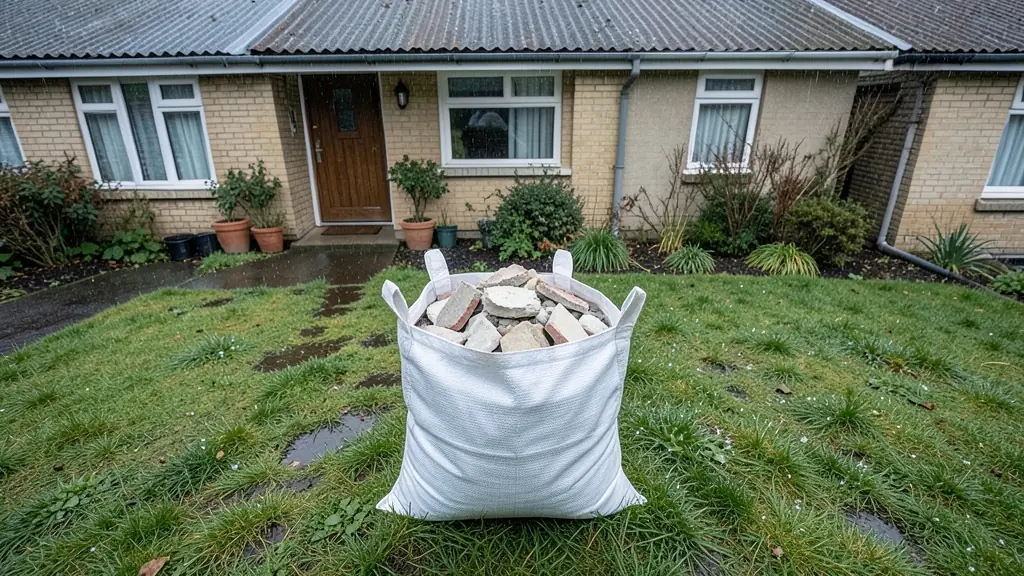
The bathroom you are stripping is at the back of a semi in Observatory, and the only way out is through the passage and the lounge. A skip on the street means wheelbarrow after wheelbarrow over the floors you want to keep. Rubble bags turn that around: the bag stands next to the work, you fill it there, and a crane truck lifts it over the wall or the roof edge when it is full. Also sold as bulk bags for rubble or skip bags, they suit small and awkward jobs. Here is how to use them well.
Put the bag where the rubble is, not where the truck is
The point of a bulk bag is that you stop carrying. Stand it on the patio outside the bathroom window, in the back garden beside the old wendy house, or in the yard behind the shop. Fill it straight off the shovel. When it is full, it waits there for the truck.
That only works if the crane can reach. So before you place the bag, find out where the truck will park and how far its arm stretches, and put the bag inside that reach. A bag in the wrong place is just a very heavy pile. If the rubble is in the front of the stand with good access, a mini skip may be simpler.
The crane's reach and what lies under its path
- Overhead wires: the street and house supply lines between the truck and the bag.
- Trees and roof overhangs: a bag swung over a gutter or through a jacaranda takes both with it.
- The distance from the kerb: ask the operator the reach in metres and measure it yourself.
- Where the truck stands: a firm, level spot on the road or verge, not over a stormwater grid.
- The neighbour's side: nothing should swing over their property without them knowing.
Problem: cause
- The bag split on the lift: a thin bag from a hardware shelf, or one filled with wet screed far past what it was made for.
- The driver refused to lift it: too heavy for the crane at that reach, or out of reach altogether.
- An extra charge on the invoice: soil, concrete or mixed waste in a bag quoted for light rubble.
- A week in Cape winter rain: the plaster turned to sludge and the bag got heavier. Cover it.
Filling a bulk bag so it lifts cleanly
- Open it on flat, firm ground with all four loops standing up and clear.
- Put broken bricks and heavy pieces in first, light waste on top.
- Stop at the fill line, or below it for concrete and soil. Check with the skip size calculator.
- Keep timber, rebar and roof sheet ends from poking through the weave.
- Leave no loose bricks on top to fall when it swings.
What to put in your request
- How many bags and what goes in them
- Where each bag will stand on the stand
- Distance from the kerb to the bags
- Wires, trees or roofs in the crane's path
- When the bags will be ready to lift
Rubble Bags for homes, builders, sites, complexes and farms
- Homeowners: a bag on the back patio for the old shower and tiles, lifted over the wall
- Builders and renovators: a bag outside each bathroom window on a strip-out, swapped as each fills
- Developers and main contractors: bags on upper floors and tight corners where skips and trucks cannot get near
- Complexes, estates and landlords: a bag behind a unit in a complex that allows no skips on its paved roads
- Shops, offices and schools: bags in the service yard behind a restaurant for a small fit-out over two nights
- Factories, warehouses and mines: bags beside a plant room for broken plinths and sweepings, lifted by crane
- Municipalities, churches and NGOs: bags at a school or clinic for small repairs, filled by staff and lifted later
- Farms and smallholdings: bags of old plaster and roof tiles from a labourer's cottage, collected in one trip