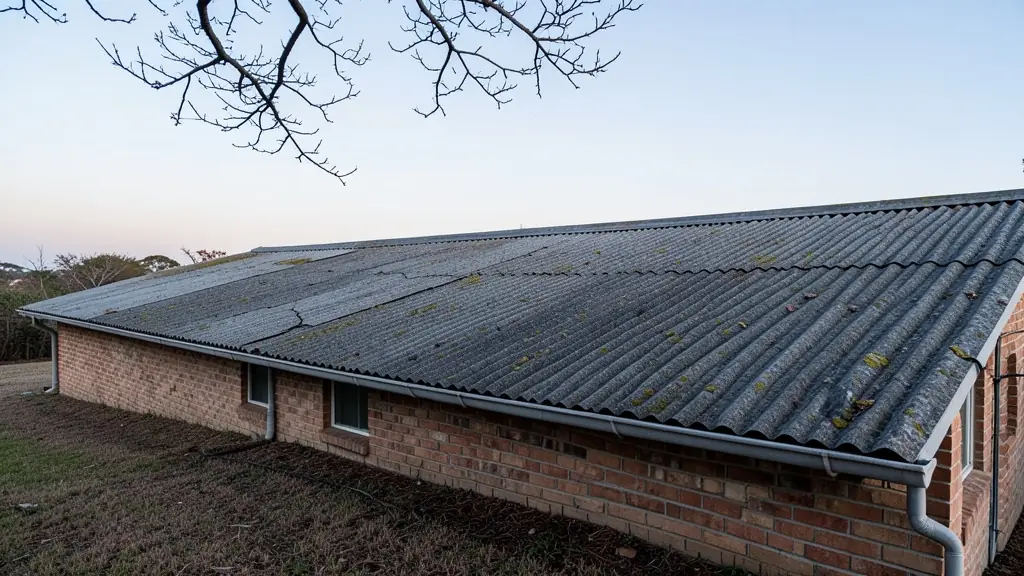
That grey corrugated roof on the garage or the servants' quarters, put up in the seventies, is very likely asbestos cement. Many South African houses and outbuildings built before about 1990 have it in the roof sheets, the gutters and downpipes, some ceilings and old water pipes. Left whole and undisturbed it is not the urgent risk people fear; broken, drilled or cut it releases fibres. Asbestos removal is therefore not a job for a rubble team or a skip. A registered asbestos contractor must do it, and the rules cover the work plan, the disposal and the clearance.
Where asbestos cement usually turns up
- Roofs: wide, grey corrugated sheets on houses, garages, carports, farm sheds and factories.
- Gutters and downpipes: heavy, grey and thick walled, often on the same buildings.
- Ceilings and eaves: flat boards in some older houses and outbuildings.
- Pipes: old water and sewer pipes, and some flues.
You cannot be sure by looking. A contractor or a lab can test a sample; do not cut one off yourself.
What not to do while you wait for quotes
- Do not break, drill, sand or cut the sheets: that is what releases the fibres.
- Do not high pressure clean the roof: it strips the surface and spreads the slurry.
- Do not throw broken pieces in a skip or the bin: it must go to a licensed site that takes asbestos.
- Do not let a general builder strip it with the renovation: ask for proof of registration first.
If you are planning a renovation or a demolition, the asbestos comes out first.
What a registered contractor handles
The Asbestos Abatement Regulations, 2020, under the Occupational Health and Safety Act, set out how the work is done. In general terms, the contractor prepares a work plan, notifies the Department of Employment and Labour, keeps the material wet while it comes off, wraps it, and takes it to a licensed site that accepts asbestos. Where the rules require it, an approved inspection authority checks the air afterwards.
Ask each contractor to show their registration, explain their plan and give you the disposal paperwork and any clearance certificate at the end.
Pricing it, and putting the new roof on
Asbestos removal is usually quoted per m² of roof or per job. The cost in South Africa moves with the area, the height and pitch, access, how broken the sheets are, the distance to a site that takes asbestos and whether testing and air clearance are included. Measure the roof in plan with the demolition waste calculator to give a rough size.
Plan the replacement roof at the same time, so the building is not open to the Highveld summer storms or the Cape winter rain for long between the old roof coming off and the new one going on.
What to put in your request
- What it is: roof sheets, gutters, ceilings
- A rough area in m² and the roof height
- The building's age and how it is used
- Whether the sheets are cracked or broken
- Whether you want a new roof quoted too
Asbestos Removal for homes, builders, sites, complexes and farms
- Homeowners: an asbestos cement roof on a garage, carport or outbuilding from before about 1990
- Builders and renovators: asbestos found before a renovation, removed by a registered contractor before work starts
- Developers and main contractors: asbestos surveyed and removed from older buildings before demolition on a redevelopment site
- Complexes, estates and landlords: old asbestos roofs or gutters across a complex, planned and replaced block by block
- Shops, offices and schools: an older shop, school or office with asbestos ceilings or roof sheets to replace
- Factories, warehouses and mines: factory and warehouse roofs, pipe lagging and flues from an older plant
- Municipalities, churches and NGOs: schools, clinics and halls with old asbestos roofs replaced through a public works project
- Farms and smallholdings: old asbestos sheds, stores and workers' houses on a farm, replaced before they break