
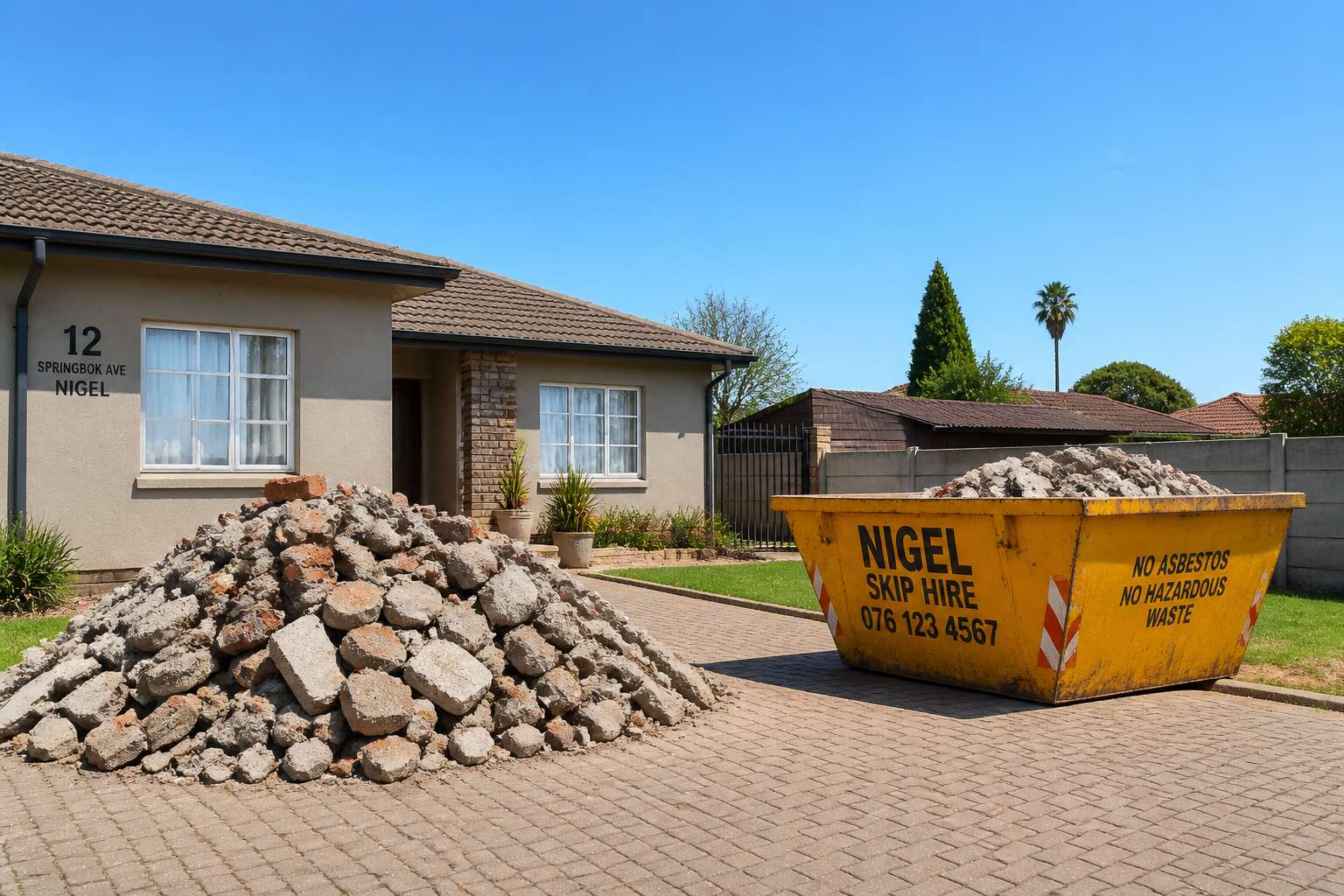
Understanding Rubble and Construction Waste
Common Types of Rubble Generated at Residential and Commercial Sites
South Africa’s construction sector produces thousands of tons of builder’s waste each year, and identifying what sits in your skip is the first step toward proper clearance. Residential renovations yield broken concrete, clay bricks, ceramic tiles, and plaster offcuts. Commercial demolitions add reinforced steel, glass panels, and asphalt surfaces to the pile.
Typical loads include:
- Concrete and masonry from load-bearing wall removals
- Timber beams, roof trusses, and door frames
- Excavated soil mixed with rubble and old paving blocks
Each material demands different handling. Inert waste like brick and concrete can be crushed and reused as backfill, while asbestos sheeting requires specialist protocols before a rubble removal nigel contractor can proceed. Knowing these distinctions keeps your project compliant, your timeline realistic, and your budget intact.
Why Proper Rubble Disposal Matters for Safety and Hygiene
An unguarded pile of builder’s waste is a hazard with sharp edges, hidden nails, and no sense of caution. Every year, South African emergency rooms treat cuts, punctures, and worse from people who underestimated a heap of broken tile or twisted rebar. Understanding rubble means respecting those risks, from rusty wire to splintered timber to the fine dust that lingers long after the loader leaves.
The hygiene angle deserves equal attention. Damp rubble attracts rodents. Decomposing gypsum board emits unpleasant odours. Stagnant water pooling inside old tyres becomes a mosquito nursery.
Proper disposal removes these dangers before they multiply. A reputable rubble removal Nigel contractor sorts, hauls, and rehabilitates the site. That keeps your property safe, your neighbours on friendly terms, and your conscience clear.
The Difference Between Rubble, General Waste, and Hazardous Materials
In polite Nigel society, the contents of a skip bin invite silent judgement. Mix a tangle of scrap metal with old paint tins and you have created an unsorted pile that no responsible hauler will touch. Understanding waste categories spares you that awkward phone call.
Rubble is the inert detritus of construction: broken brick, concrete, ceramic, and masonry. General waste covers household refuse and biodegradable material. Hazardous materials, by contrast, are legally regulated. Asbestos, lead paint residue, and solvent-soaked rags require specialised handling.
- Rubble: crushed and often recycled.
- General waste: destined for landfill.
- Hazardous: tracked, licenced, and never mixed.
A reliable rubble removal Nigel provider will sort these without flinching. Get the labels right, and the truck arrives on time. Get them wrong, and your project stalls on a technicality.
How to Estimate the Volume of Rubble on Your Property
Few property owners realise that a single cubic metre of broken brick and concrete can weigh more than two tonnes. That figure dictates the size of the truck, the number of loads, and the final invoice for rubble removal Nigel contractors quote. Estimating volume correctly prevents overpaying and the awkward surprise of a half filled skip.
Clear the pile’s edges first. Then take three measurements:
- Length: the longest horizontal span of the debris.
- Width: the widest point, measured perpendicular to the length.
- Depth: the average height, taken from several spots since rubble rarely settles evenly.
Multiply those numbers to get cubic metres. I add a 10% buffer because loose material compacts once loaded, and hidden voids in a masonry pile can mislead even careful eyes. Accurate volume is what separates a smooth rubble removal Nigel job from a stalled site and a second booking.
Local Regulations and Permits in Nigel
Municipal Waste Disposal Rules for Nigel Residents
In Nigel, the municipal waste disposal rules are clear: construction rubble cannot join the weekly kerbside collection. The Ekurhuleni Metropolitan Municipality treats building waste as a separate stream, and any rubble removal Nigel project, from a modest garage demolition to a full site clearance, must follow that framework. A waste management permit is required before a private carrier can tip a load at the licensed landfill site. Without that permit, you could face a fine for illegal dumping.
The permit process depends on the volume of material and the vehicle used. For a rubble removal Nigel job, the municipality may require:
- Proof of load origin from the property owner
- A registered transporter’s details and vehicle registration
- An approved disposal slip from the landfill facility
These rules stop unofficial operators from turning vacant land into a dumping ground and help officials track how much building debris enters the system each month.
When You Need a Waste Removal Permit
A single bakkie load of broken bricks might go unnoticed, but that is not how the system works. In Nigel, the moment your rubble leaves the property, the paperwork matters. If you hire a private carrier for rubble removal Nigel, the permit requirement kicks in before loading begins.
You need a waste removal permit when the load exceeds the small-quantity threshold set by Ekurhuleni. That threshold is lower than most homeowners expect. A bathroom renovation alone can push you past it. Here is what triggers the permit:
- Any load carried by a vehicle with a payload over one ton
- Rubble mixed with soil or vegetation that requires sorting
- Demolition debris from structures larger than a single outbuilding
Without that permit, the landfill gate stays shut. Carriers know this, and so should you.
Restrictions on Dumping Rubble in Landfills and Green Belts
The green belts around Nigel carry their own quiet authority. These protected zones are monitored, and dumping rubble there triggers penalties beyond a simple fine. Ekurhuleni’s bylaws classify green belt waste as an environmental violation. Landfill gates remain shut to unpermitted loads, and the gate staff recognise the difference between a clean demolition load and refuse dragged from a stormwater drain.
Rubble removal Nigel operators face routine inspections. Loads are scrutinised for contamination. Mixed soil, vegetation, or hazardous fragments send entire trucks away. Landfills operate under strict volume quotas, and unauthorised dumping in green belts contaminates groundwater supplies.
Restrictions follow a clear logic:
- Unseparated rubble mixed with organic waste gets rejected
- Loads exceeding permit thresholds are turned back
- Debris without documented origin is confiscated
The fines escalate with each repeat offence. Skip the loopholes.
Penalties for Illegal Dumping in the Nigel Area
Penalties for illegal dumping in the Nigel area carry weight that many property owners underestimate. The Ekurhuleni Environmental Health Department issues spot fines starting at R2,000 for first offences, but repeat violations climb swiftly. I have watched contractors face five figure penalties plus forced remediation costs.
Local regulations require a waste manifest for any load exceeding 500 kilograms. The permit process runs through the Nigel Waste Management Office, and inspections happen without notice. Missing paperwork means your rubble removal nigel load gets impounded, not merely redirected.
- First offence: R2,000 to R5,000 spot fine
- Second offence within 12 months: R10,000 fine and possible vehicle impoundment
- Third offence: criminal charges under the Environmental Conservation Act
Enforcement officers photograph every illegal dump site. Those images become court evidence, and property owners are traced through municipal utility records. The legal exposure reaches far beyond the fine itself.
Rubble Removal Methods and Equipment
Manual Removal vs. Mechanical Loaders: Pros and Cons
A pile of rubble at the gate represents a decision point. Property owners in Nigel soon realise that clearing debris requires a strategic choice, not just muscle. The methods you employ will affect your timeline, your back, and your budget.
Manual removal remains the most precise approach. Labourers with wheelbarrows and sledgehammers can dismantle brickwork and separate rebar from concrete with a level of control that machines simply cannot match. This method excels in confined spaces where a front-end loader would struggle to manoeuvre. For smaller projects, such as a collapsed garden wall, hand tools offer the flexibility to salvage usable materials on site.
– Manual removal suits tight corners and narrow passageways.
– It allows for careful sorting of recyclable aggregates.
– It minimises the risk of damaging underground pipes or cables.
Mechanical loaders, by contrast, offer raw efficiency. A skid-steer loader can fill a five-ton truck in under an hour, a task that would take a crew of four an entire day. The trade-off involves the cost of hiring the equipment and the space required to operate it safely. Larger machines also produce dust and vibration, which demands consideration for neighbouring properties.
The real distinction lies in the rhythm of the work. Manual labour staggers the process, keeping the team engaged with the sorting and stacking. Mechanical removal compresses everything into a burst of activity, ideal for clearing a large slab or a demolished outbuilding. This distinction is not about which method is inherently superior. It is about matching the tool to the scale of the challenge.
Property owners who weigh these options carefully often discover that a hybrid approach works best. A loader handles the bulk earthmoving while a small crew clears the remnants by hand. This combined strategy reduces reliance on any single resource and keeps the project moving. Experienced hands here in Johannesburg note that attention to the method, rather than the speed, prevents costly rework. The rubble removal nigel companies recommend assessing the site access first, as this single factor often dictates the entire approach. A wise contractor plans the removal sequence before a single brick is lifted, ensuring that the debris flows out of the property as quickly as it was created.
Skip Hire and Roll-On Roll-Off Containers for Large Volumes
When a project in Nigel requires clearing several tons of concrete and brick, skip hire delivers a pragmatic solution. A standard skip holds roughly six cubic metres of debris, though the true value emerges with roll-on roll-off containers. These heavy duty units open from the top and slide onto a truck bed, accommodating volume that would overwhelm smaller bins. I have watched a site in Springs fill a thirty cubic metre container within a single afternoon. The operational simplicity matters as much as the capacity.
– Roll-on roll-off containers suit demolition remnants and excavation spoil.
– Skip hire offers flexibility for ongoing work, as containers can stay for days.
– Both methods reduce handling since debris gets tossed directly into the opening.
For rubble removal nigel residents managing large volumes, this equipment eliminates the need for repeated trips. The choice between a skip and a roll-on unit depends on how much rubble sits on the property. A straightforward skip serves moderate loads, while roll-on roll-off containers handle the monstrous piles without fuss.
Same-Day Rubble Collection Services and Their Benefits
Construction work never follows a perfect timetable. When a project runs long or a surprise collapse occurs, that pile of broken concrete cannot wait for next week’s collection slot. Same-day rubble removal services exist for these exact moments. A truck arrives, the debris disappears, and your site returns to usable condition before sunset.
The mechanics of same-day collection are straightforward. You place a call in the morning, describe the volume, and a driver confirms an arrival window. The crew loads the rubble directly onto the vehicle, eliminating the intermediate step of filling bags or stacking materials at the curb. For rubble removal nigel property owners, this compressed timeline reduces safety risks and keeps neighbours satisfied.
Several distinct advantages emerge from this approach.
1. Urgent clearance after storm damage or structural failures prevents further deterioration.
2. Compliance with municipal regulations happens faster, reducing exposure to penalties.
3. Site inspections and property handovers proceed without delay.
4. Contractors maintain momentum on sequential tasks.
The real benefit is psychological. A clean site signals progress. Workers move with greater confidence when they are not stepping over debris. Homeowners feel relief when their driveway returns to usable condition. Same-day collection transforms a stressful situation into a manageable administrative task, and that matters when deadlines loom.
Equipment Used by Professional Rubble Removal Teams
There is a particular sound that signals the start of a proper rubble removal operation. It is not the crunch of debris but the measured hiss of hydraulic stabilisers on a side loader. Equipment determines the speed and safety of the entire job, and the difference between an amateur and a seasoned team is visible in the hardware they deploy.
Professionals assess the site before a single brick is lifted. They check for buried cables, loose overhangs, and load-bearing considerations. The tool that works for a narrow passage between townhouses will fail on an open construction lot. That is why a good crew arrives with a varied arsenal rather than a single brute force approach.
The standard inventory includes the following:
- Mini excavators with hydraulic breakers for demolition of reinforced concrete.
- Skid steer loaders for shifting loose material into skip bins.
- Industrial screeners that separate soil and fine particles from reusable stone.
- Magnetic separators to extract scrap metal before it jams a crusher.
- Telescopic handlers for reaching elevated debris on multi-storey renovations.
There is a method to the apparent chaos. The crew works in a deliberate sequence. First comes the sorting phase, where hazardous materials are flagged and removed by hand. Then the mechanical loaders take over, each pass reducing the pile with surprising efficiency. Finally, a magnetic sweep ensures the aggregate that remains is clean enough for transport. This process is particularly relevant for rubble removal nigel residents, where landfill restrictions demand that loads arrive sorted to avoid refusal.
I have watched these teams work on tight suburban driveways where a single mistake would damage a neighbour’s fence. The precision is almost surgical. A mini excavator inches forward, its operator reading the ground with a patience that contradicts the urgency of the task. Within hours, what seemed like a mountain of rubble is reduced to a neat stack of reusable brick and a truckload of waste.
Of course, the equipment is only as good as the hands that operate it. A professional driver does more than lift and dump. They balance the load distribution on the vehicle to prevent accidents on uneven terrain. They know when to pause and re-evaluate. It is this combination of robust machinery and human judgement that turns a messy demolition site into a clean canvas for the next phase of work. That is the quiet competence that separates a proper service from a half-hearted attempt, and it is exactly what property owners in the Nigel area should expect when they request a quote.
Access Challenges: Navigating Narrow Driveways and Restricted Spaces
When a demolition job sits at the end of a hairpin driveway, the real battle begins before the first load is shifted. Measuring the access route is the first task, and often the most revealing. A crew that bypasses this step sets itself up for costly delays when a vehicle simply cannot turn.
Tight spaces demand specific tactics. The professional approach favours smaller, more agile machinery that can pivot within its own footprint. Consider these methods for restricted sites:
– Use compact tracked dumpers instead of large trucks to move material in smaller, controlled loads.
– Deploy conveyor systems to bridge obstacles like walls, fences, or garden features.
– Position a skip at the curb and use manual labour for the final stretch, a slower but unavoidable method.
The challenge intensifies when overhanging trees or low-hanging cables reduce vertical clearance. A standard tipper is useless here. Operators might hand-ball rubble into a smaller vessel, or dismantle obstacles with a chainsaw and careful webbing. Every inch of play is measured twice.
For rubble removal nigel properties with narrow driveways, the process often becomes a choreography of short runs. A wheelbarrow crew feeds a hopper stationed at the property line. The mechanical lifter never enters the site. This hybrid approach protects paving and keeps the job moving, yet it relies on the crew’s patience for the manual grind. A thorough team assesses these constraints during the quote, so the final price reflects the true labour, not a hopeful estimate.
Safety Gear and Protocols During Rubble Handling
Proper rubble removal nigel operations depend on matching the method to the material. Mechanical crushers reduce concrete slabs on site, while magnetic separators pull embedded rebar from the pile. For mixed debris, a grapple attachment sorts faster than any gloved hand.
Safety protocols govern every lift. The essential gear includes:
- Dust masks and safety glasses for airborne particles
- Steel-capped boots and cut-resistant gloves
- High-visibility vests for the drop zone
Operators check slings and shackles before each hoist, and spotters maintain clear communication with hand signals. The equipment itself demands inspection. Hydraulic lines, quick couplers, and bucket teeth wear silently. A daily checklist catches these faults before they become failures. Rubble removal nigel teams that skip this step trade a minute of inspection for hours of downtime.
Choosing the Right Rubble Removal Service
Key Questions to Ask Before Hiring a Removal Company
Choosing a rubble removal nigel company often feels like a game of chance, but it should be a transaction grounded in evidence. A startling 40% of construction waste ends up in illegal dumping sites, which means the person hauling your debris could be a liability in disguise. Before you accept a cheap quote, remember that you are entrusting them with your legal reputation, not just your broken bricks.
Ask pointed questions about their destination facilities and their compliance with municipal bylaws. A reputable provider will offer clear details without hesitation.
Here are the essential inquiries to make before any work begins:
1. Where exactly will this material be taken?
2. Can you provide a reference from a similar project?
3. What is your protocol for unexpected hazardous waste?
A company that prides itself on transparent rubble removal nigel operations will welcome your scrutiny. If they answer with vague gestures toward the east rand, consider it a red flag. Your driveway may be a mess, but the paperwork should never be.
Verifying Licenses, Insurance, and Certifications
A contractor’s license is the first thing they’ll show you, and the last thing you’ll verify. Paperwork determines whether a rubble removal nigel operation is legitimate. A provider’s license confirms they operate within municipal boundaries, while insurance protects you from liability if a wall collapses or a worker gets injured on your property. Certifications show that safety standards are actually met, not merely claimed.
- Ask to see their waste carrier registration and public liability cover before they arrive.
- Verify that their certifications cover the specific equipment they’ll use on your site.
- Confirm that their insurance extends to subcontractors if they plan to bring any.
I’ve seen homeowners trust a quote without checking the paperwork behind it. One phone call to their insurer or the relevant council office can reveal expired policies or lapsed registrations. Don’t rely on a laminated certificate in a glovebox!
Reading Reviews and Getting Referrals from Local Neighbours
When choosing a rubble removal nigel service, the accounts of nearby residents carry more weight than any promotional material. Neighbours who recently completed renovations will readily share their experiences, often with candour reserved for close acquaintances. Their stories reveal what brochures omit.
Observe how the rubble removal nigel team left the property. Were the driveways swept clean? Did the crew arrive on time and respect quiet hours? Such details surface only through conversation.
- Ask neighbours about punctuality and hidden fees.
- Request to see the finished state of their driveways.
- Enquire whether the crew handled rubble separation correctly.
Online reviews serve a purpose, yet they lack the texture of a face to face account. Combine both sources before committing.
Comparing Quotes: Hidden Fees and Transparent Pricing
When comparing quotes for rubble removal nigel services, the lowest figure rarely tells the full story. Pricing structures vary widely, and some providers add charges for fuel, skip hire, or extra labour once the truck arrives on site. A reputable company will itemise every cost before work begins.
Ask for a written breakdown. Confirm whether the price covers loading, transport, and disposal fees. Some quotes exclude the landfill tipping fee, which can inflate the final bill substantially. Be wary of verbal estimates that shift once the crew sizes up the load.
Transparent pricing means no surprise surcharges for access challenges or mixed rubble. You should receive one clear figure with the terms spelled out in plain language. That clarity protects your budget and keeps the job running smoothly.
Red Flags to Avoid in Rubble Removal Contractors
Scrutiny makes a good rubble removal nigel contractor comfortable. Red flags appear when a company dodges basic questions about where your rubble will end up. If a contractor cannot name a licensed landfill or recycling facility before the truck arrives, that is a signal to walk away. Vague answers often hide illegal dumping, and the fines may follow you, not them.
Watch for pressure tactics. A caller who insists you commit today or demands cash upfront is pushing a high-pressure sales approach, not offering a service.
- Unmarked vehicles with no company branding.
- Refusal to provide a street address or landline number.
- Full payment requested before any rubble is loaded.
- Quotes that jump after the crew inspects the site.
Contractors with nothing to hide welcome verification. One who rushes you or avoids written commitments deserves caution. The right rubble removal nigel partner keeps the process straightforward and predictable.
Cost Factors and Pricing Structures
How Rubble Weight and Type Affect Your Final Bill
Your final rubble removal Nigel quote often hinges on two slippery variables: the weight of the load and the actual type of material. A pile of broken bricks weighs less per cubic metre than a slab of reinforced concrete. That difference changes the bill because transport costs scale with tonnes, not volume. Dense rubble forces the crew to make fewer trips but use more fuel per trip. Meanwhile, mixed loads containing plasterboard or timber introduce sorting fees, since those materials cannot go to the same disposal site. Hazardous items like asbestos inflate costs further; specialised handling and permitting kick in.
Some contractors list a base rate per tonne, then adjust.
- Concrete and brick: standard pricing, but heavy.
- Mixed demolition waste: extra for segregation.
- Contaminated soil or asbestos: premium charges apply.
Always ask for a breakdown by weight and type, because vague estimates often hide these variables.
Average Pricing Ranges for Rubble Removal in the Region
In Nigel, the price for rubble removal nigel often hinges on how a contractor structures their rates. Some charge a flat fee per load, while others tally up by the hour or by the volume of debris. This mismatch means two identical piles of broken concrete might earn quotes that differ by nearly a thousand rands.
Average pricing ranges in the region settle into a workable zone:
- R1500 to R2500 for a standard bakkie load of mixed demolition waste.
- R3000 to R5000 for a full cubic metre of concrete or brick rubble.
- R7000 and upward for heavy loads that demand a roll-off skip.
These figures flex with fuel costs and landfill tariffs. A company that builds sorting or recycling into its quote may look pricier at first glance, but it often spares you from surprise surcharges once the truck arrives. Always request a written price before the crew starts, and remember that rubble removal nigel thrives on clarity, not guesswork.
Additional Charges for Travel Distance, Disposal, and Labour
Travel distance is often the first variable. A crew based in Springs may charge extra to reach your Nigel property. Disposal tariffs at registered landfills also fluctuate, so the quote today might not match tomorrow’s fee.
Labour costs shift with the job’s complexity. A straightforward bakkie load needs one or two workers, but a confined space or a heavy concrete slab could require more hands and more hours. When you compare rubble removal nigel services, ask for a breakdown that separates transport, dumping, and labour.
- Travel fee per kilometre beyond a set radius
- Landfill gate fee, often passed through with a markup
- Hourly rate for extra workers or waiting time
Those extras can raise a R1500 quote to a R2500 invoice. Request the total in writing before loading starts.
Ways to Reduce Costs Through Sorting and Recycling
A clean pile of bricks costs less to remove than a chaotic mound of mixed debris. That distinction shapes every rubble removal nigel quote. Mixed waste forces crews to sort at the landfill, and that time appears on your invoice. Separated piles move faster through the weighbridge, which trims both labour and gate fees. Ask for a breakdown of the per-tonne rate, transport fee, and disposal charge to see where your money goes.
Sorting on site is the most direct way to reduce expenses. Separate your rubble into:
- Metal
- Wood
- Clean concrete
Recycling yards often accept these items for free or even pay scrap value, lowering the weight you’re billed for. Neatly bagged or bundled materials also speed up loading, meaning fewer billable hours. That is the simplest lever you can pull.
Environmental Impact and Sustainable Disposal
Recycling Rubble into Aggregates and Building Materials
Each tonne of concrete rubble that gets crushed into aggregate saves roughly 0.9 tonnes of carbon emissions compared to quarrying fresh stone. In Nigel, the push toward circular building practices is changing how we view demolition waste. Rubble removal Nigel services now sort materials on site, diverting clean brick and concrete from landfill. This material becomes sub-base for roads or new concrete blocks.
Sustainable disposal starts with separation. Clean concrete, brick and tile can be crushed into graded aggregate. That aggregate replaces virgin stone in drainage layers, paving bases and even new precast elements. It is not a niche practice. It is standard in many European municipalities, and South African cities are catching up.
Common reclaimed fractions include:
- Crushed concrete for road sub-base
- Recycled brick chips for landscaping mulch
- Reused timber beams for structural elements
The environmental payoff is measurable. Less quarrying means fewer disturbed hillsides, reduced haulage emissions and lower truck traffic on local roads. Landfill space stays free for true waste. I have watched a single residential renovation in Nigel produce twelve cubic metres of crushable rubble. With the right processing, that becomes a resource, not a liability. Sorted loads also avoid mixed waste charges. Ask your provider if they run a crusher or partner with one. Some materials, like gypsum board or treated timber, cannot be recycled this way. They need separate handling.
Reusing Clean Rubble for Landscaping and Driveway Bases
Clean rubble has a second life beneath your feet. A crushed concrete base often outperforms imported gravel, and it keeps demolition waste out of the local landfill. For Nigel homeowners, the driveway is the most visible beneficiary.
- Crushed brick chips for footpaths and garden edging
- Concrete rubble for a stable driveway sub-base
- Stone screenings for drainage behind retaining walls
The shift is practical. When you book rubble removal nigel, ask whether the clean fraction is crushed on site or trucked to a nearby crusher. Sorted loads skip mixed waste tariffs, and the resulting aggregate costs less than quarried stone. Landscaping projects around this region increasingly specify these recycled materials as the standard choice. That is a change you can feel in the ground itself.
The Role of Registered Recycling Depots in Sustainable Waste Management
Every tonne of rubble that bypasses the landfill spares two resources: the airspace it occupies and the virgin aggregate needed to replace it. In Nigel, this double saving depends on one link in the chain, the registered recycling depot.
A registered facility operates under environmental authorisation. It monitors runoff, screens for contaminants and keeps clean rubble separate from hazardous waste. Unregistered sites often skip these steps and simply bury the material. The cost surfaces years later in polluted groundwater.
When you book rubble removal nigel, ask which depot will receive the load. Confirm its registration number and request the weighbridge ticket. Responsible operators track every load from source to final destination, which means:
- Accurate documentation for municipal records
- Guaranteed legal disposal with no hidden dumping
- Segregation of clean aggregate for future reuse
That last point matters. Rubble that reaches a registered depot gets processed, not entombed. It returns to the building cycle and keeps Nigel’s soil and water intact for the next generation. Choose a rubble removal nigel service that treats the depot as a partner, not a drop-off point.
How Professional Services Ensure Compliant and Eco-Friendly Disposal
A single abandoned load of rubble can smother a Nigel wetland for decades. The weight compacts the soil, blocks natural drainage and silts up the pans that seasonal rains depend on. This is why professional rubble removal nigel services treat disposal as an environmental obligation, not an afterthought.
Compliant operators route every load to a licensed facility where it is sorted, screened and recycled. Clean brick and concrete are crushed into aggregate for future construction, while contaminated material is isolated. This closed loop keeps toxic residue away from the groundwater and reduces the need for virgin quarrying.
Eco-friendly disposal also means fewer trips. A rubble removal nigel team consolidates material into one vehicle, lowering fuel use and emissions across the region. The outcome is straightforward: your site is cleared, the material returns to the building cycle and Nigel’s natural systems remain intact.


0 Comments