
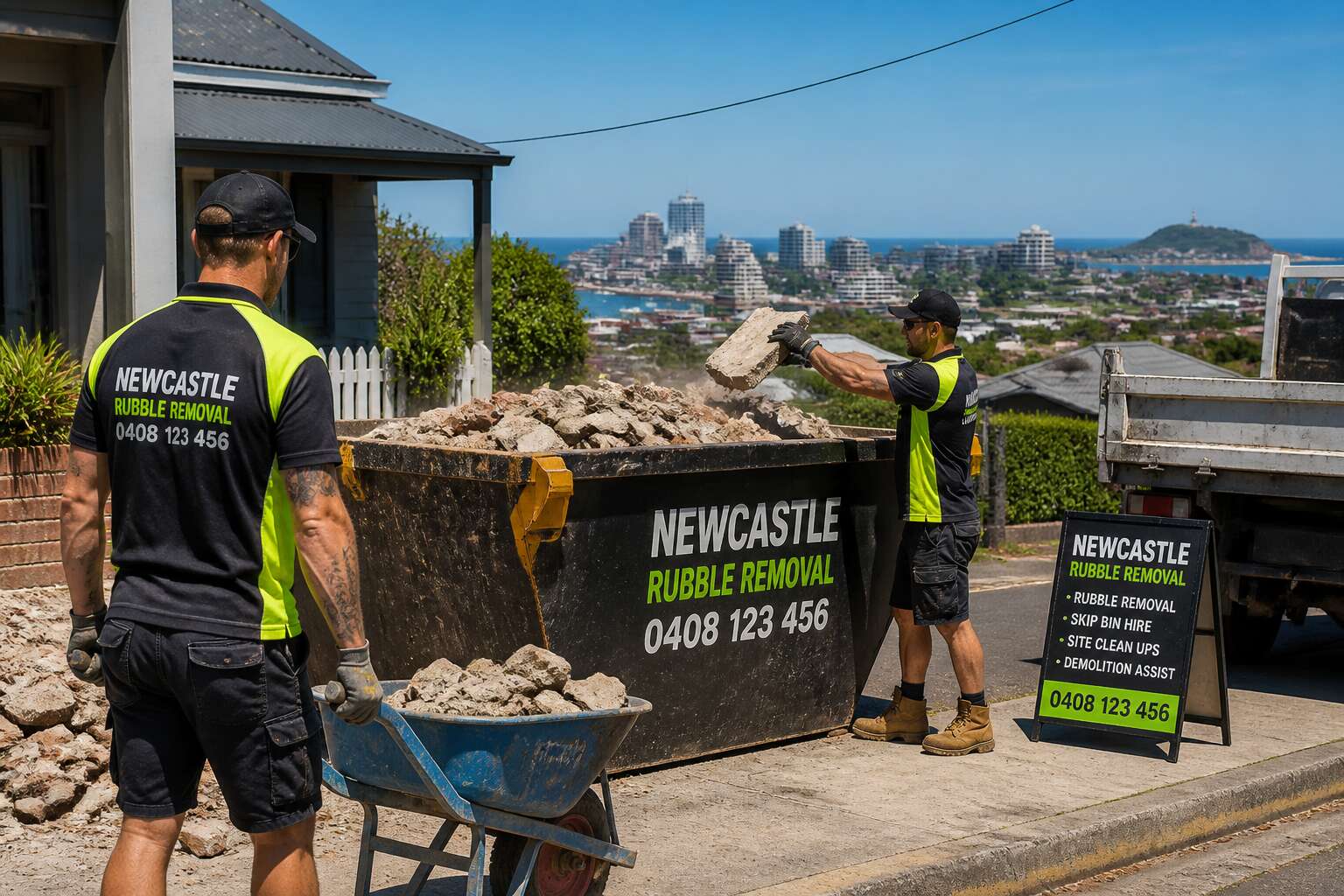
Understanding Rubble Clearance Services in Newcastle
Defining Rubble and Construction Waste
Stand on any demolition site in Newcastle and you will see the same scene: piles of broken brick, cracked concrete, and shattered tile. That material is rubble, and it demands proper handling! Rubble differs from construction waste, which includes wood offcuts, cardboard, and plastic sheeting.
Common rubble items include:
- Broken concrete slabs and blocks
- Bricks and masonry offcuts
- Tiles, ceramics, and stone
- Asphalt and road planings
Professional rubble removal Newcastle crews handle these categories separately. In my experience, rubble often goes to crushing plants for reuse as aggregate, while general construction waste heads to landfill or recycling facilities. That separation drives compliance and cost, so a service that knows the difference makes the process simpler.
Why Professional Clearance Is Often Necessary
In Newcastle, a skip of mixed rubble can weigh more than a small car. That weight is a physical problem, but also a legal one. Handling it without the right equipment puts people at risk. Back injuries happen. Fines happen. Loads rejected at the tip happen!
A professional rubble removal Newcastle crew brings the right vehicles and the right certificates. They know which sites take crushed concrete and which take asphalt. They know local tipping fees. More importantly, they know how to sort on the spot. That sorting keeps materials out of landfill and stops customers paying for disposal twice.
A skip on the kerb is not a clearance service. It is a pile waiting to be managed. The difference shows in the paperwork and the final site condition.
Typical Scenarios That Generate Rubble
Newcastle’s construction sector hums with a quiet intensity. Every renovation, every demolition, and every site clearance leaves behind a physical echo in the form of broken concrete, brick, and asphalt. When you look at a pile of that debris, you are not just seeing waste. You are seeing a logistical problem that needs a defined solution. A professional rubble removal newcastle service operates on a simple premise: they evaluate the volume, assess the material composition, and execute a removal plan that accounts for the region’s specific waste regulations. The work involves more than just lifting heavy objects. It involves a careful survey of the site to identify hazardous elements that might be mixed into the rubble, such as wire mesh or old plumbing fixtures.
The scenarios that generate this volume of waste are surprisingly common across the city. You might be managing a residential extension where the old foundation needs to come out, or you could be dealing with the aftermath of a structural fire that has left behind charred bricks and broken blocks. Each job has its own character.
– Full property demolition where the structure is beyond repair
– Interior strip-outs that remove partition walls and old flooring
– Commercial site redevelopment that requires clearing old parking lots
– Storm damage cleanup that leaves behind scattered masonry
In every case, the material is heavy and unforgiving. A vehicle without the proper suspension will struggle, and a driver without local disposal knowledge will face rejected loads. This is why a dedicated crew is not just a convenience. It is the necessary link between a messy site and a clean, safe environment.
How a Standard Clearance Process Works
A clearance begins before the first shovel touches the pile. I have watched crews walk a site, measuring angles, checking access points, and counting the weight of what waits in the shadows. That initial survey determines which vehicle can reach the debris, how many loads the job will take, and which materials can be diverted from the landfill. For rubble removal newcastle, the process follows a sequence: separate the reusable brick and concrete, break down oversized pieces to fit the truck’s capacity, and document each load for the disposal facility.
Every step happens with a deliberate certainty. The driver knows the weighbridge protocol, the tipping fees, and the compliance paperwork required by municipal bylaws. It is unglamorous work, but the rhythm of it never falters! By the time the last truck pulls away, the site carries no trace of what once stood there.
Types of Rubble and Waste Materials Handled
Concrete, Bricks, and Masonry
Concrete is the most stubborn element in any ruin. A broken slab seems to double once it hits the ground, and each wheelbarrow carries a silent insult to the back. A proper rubble removal Newcastle plan begins with densities, not appearances. At about 2.4 tonnes per cubic metre, one modest patio can quickly demand a truck all to itself.
Bricks and masonry follow a quieter set of rules. They have grown old under lime and mortar, and they cling to their neighbours long after the wall has failed. In any typical pile, I have found:
- Whole bricks that fall out completely unharmed.
- Split bricks whose edges remain glued into a clump.
- Masonry blocks and broken footings that resist the spade.
The courteous operator separates these classes without being required to. A proper rubble removal Newcastle service does not judge a brick by its angle; it understands that a block will grind away at a clean brick when left together. Sorting is not glamorous work. It is the difference between a load that moves quietly and one that fights, and any decent eye can see that from the first glance.
Tiles, Ceramics, and Roofing Materials
No one anticipates the shards. A glazed tile dropped from waist height fractures into edges that split work gloves, and a ceramic basin cracks into fragments that wedge into gaps where a broom cannot reach. Roofing materials complicate the load further. A typical pile of slate, clay, and corrugated iron mixes brittle sheets with rusted fixings.
- Broken clay roof tiles, dusty and abrasive
- Glazed ceramics, sharp and unpredictable
- Slate sheets, heavy and prone to splitting
- Fibre cement and corrugated iron, awkward in size
Rubble removal Newcastle crews separate these classes before they contaminate a mixed load. One contaminated skip taints the next, and ceramics never decay; they only break into smaller, more dangerous pieces. A professional clearance understands this from the first glance at the pile.
Garden Rubble and Green Waste
After a storm, a suburban yard can turn into a local timber stand. Branches hang over the grass, roots push up the path, and the soil stays wet for days. Garden waste holds moisture, rots, and compresses. Mixed with stones, it makes a skip heavy and the disposal route complicated.
Rubble removal newcastle crews always perform a green sort first. They isolate the organic matter from plastic and metal. This is the first step toward a legal and efficient result. Common garden piles include:
- Branches and hedge trimmings
- Tree stumps and root balls
- Grass clippings and turf
- Fence posts and old planks
- Empty pots, hoses, and plastic sheeting
The compostable portion goes to a composting site. The non-rotting waste goes to a recovery facility. A clear yard is the direct outcome of a careful separation.
Mixed Renovation Debris
Mixed renovation debris refuses neat categories. One room can produce plasterboard dust, shattered ceiling tiles, offcuts of timber, and tangled wiring all in the same load. That is why rubble removal newcastle teams treat every mixed pile as a separate challenge.
Sorting matters here. Clean loads are easy to direct, but mixed debris needs a careful eye to split recyclable timber, metals, and aggregates from general waste. When materials are compacted together, the weight and the disposal route change immediately.
- Plasterboard and gypsum offcuts
- Timber studs and flooring offcuts
- Insulation offcuts and old carpet
- Packing materials, plastic film, and cardboard
A professional crew can separate these on site. The result is a lawful load and a shorter route to recovery or disposal.
Choosing a Removal Provider in Newcastle
Licensing, Insurance, and Compliance
Choosing a provider for rubble removal newcastle involves more than comparing quotes. The first thing I ask for is a valid waste carrier licence. In South Africa, transporting construction and demolition waste without this document is illegal. A reputable company will show it without hesitation.
Insurance matters just as much. A single dropped brick can damage a neighbour’s wall, and if the provider lacks public liability cover, you inherit that cost. Always verify the policy is current and covers the scope of your project.
Compliance extends to the disposal site. Licensed facilities only, with proper weighbridge tickets. Here is what to check before signing anything:
- Waste carrier registration number
- Certificate of public liability insurance
- Proof of legal dump site usage
This diligence protects you from fines and surprises.
Local Experience and Customer Reviews
Local knowledge in Newcastle shows itself in the small details. A crew that has cleared these streets for years knows the weight limits on the R25 and which landfill closes early on Saturday. They do not have to guess, and that saves a full hour on site! When I read customer reviews about rubble removal Newcastle, I filter for mentions of specific estates and streets. General praise sounds hollow. A comment about a narrow turn or a tight rear tells me more about quality than a row of stars.
A useful review includes:
- The street or estate name where they worked
- The type of waste removed from the site
- The condition of the property once the clearance ended
The same provider names repeat across the reviews for the same suburb, and that recurring name counts more than a high rating.
Fleet Capabilities and Equipment
A 6 ton tipper truck fills roughly sixty builder’s bags. That is the difference between one load and three, and it is why the fleet matters before a single brick is lifted.
The right equipment for rubble removal Newcastle depends on access, weight, and the type of waste. A provider with a range of vehicles can match the tool to the job. A compact truck handles a narrow driveway. A larger tipper suits open sites. A skip loader works where manual loading would waste hours.
When you compare providers, ask what they bring. Old equipment breaks down. Undersized trucks mean extra trips. The best crews maintain their machinery and know its limits.
– Do they have tipper trucks with payloads over 5 tons?
– Are their vehicles fitted with drop sides or tail lifts?
– Do they bring wheelbarrows, spades, and ramps?
A provider who answers clearly is one who has solved these problems before. In Newcastle, properties sit on slopes and behind gates that were built before modern vehicles. The crew that can reverse a 6 ton truck through a tight entrance without scraping a wall is the crew worth hiring. The machine is only half of it. The person behind the wheel knows how to use it. That is the real capability.
Transparent Pricing and Free Quotes
Nobody enjoys uncovering a hidden fee after the truck has rumbled away. Transparent pricing in rubble removal newcastle means you receive a free quote that breaks down every cost, including labour, transport, and disposal. A reputable provider will inspect the site, estimate the volume honestly, and then commit to that figure.
Ask these questions before you agree to anything:
- Is the quote fixed, or can it change on the day?
- Are skip hire and landfill charges included?
- Do they charge extra for difficult access or steep driveways?
If the answers come back fuzzy, treat that as a red flag. Clear pricing protects your pocket and your peace of mind. In Newcastle, decent rubble removal newcastle should feel like paying for a service, not gambling on one.
Cost Factors and Pricing Structures
Volume and Weight-Based Pricing
The price of rubble removal newcastle services swings on two variables: how much space the waste occupies and how heavy it sits on the scales. Volume and weight operate in tandem, yet savvy homeowners know the distinction. Most providers quote per cubic metre for loose waste, then adjust for density. Several elements influence the final figure:
- Material density shifts the balance between volume and weight.
- Access constraints affect loading time and equipment needs.
- Distance from the disposal site adds transport charges.
Concrete and masonry reach weight limits quickly, while lighter materials like timber fill volume without straining the scales. Smaller loads often suit a flat rate per trailer load, offering predictability. Larger projects benefit from per-tonne pricing, which rewards accurate estimation. This is where honesty pays. Overloading a bin invites surcharges, and underestimating volume means a second collection, a mistake that inflates any rubble removal newcastle budget.
Skip Hire Versus Man-and-Van Services
Choosing between a skip and a man-and-van service for rubble removal newcastle involves different cost formulas. A skip charges for the container, the permit, and often a second visit if your pile grows. Man-and-van outfits price by the trip, which sounds simpler until a van makes four journeys. The real divider is labour. Skip hire lets you load it yourself, saving money at the cost of your energy. Man-and-van includes labour, so you avoid the physical work but pay a premium. These factors shift the final price most:
- Access width for a skip lorry or van.
- Parking permit costs on narrow streets.
- Waiting time if your rubble sits behind a locked gate.
- Disposal fees at the local landfill for mixed loads.
Each factor multiplies when space is tight. A skip fits a driveway neatly, but a van squeezes through a 2-metre gap. Neither wins outright. Your choice for rubble removal newcastle depends on whether you value convenience or control.
Access Constraints and Location Premiums
Watching a driver reverse a lorry into a cul-de-sac built for bicycles taught me that rubble removal newcastle pricing is never a simple equation! Cost factors split into two camps: what you generate and where you generate it.
Volume and weight seem obvious, but landfill fees for mixed loads shift weekly. Clean brick costs less than plasterboard riddled with nails. Drivers also charge for fuel, and some Newcastle estates demand a deposit before allowing heavy vehicles through the gate.
- Distance to the nearest licensed disposal site.
- Gravel driveways that bog down heavy lorries.
- Overhead cables that block tall-bodied vehicles.
Location premiums surface when parking permits or private road rules apply. A property in the central business district with loading zones will cost more than an open plot outside town. In this industry, the final invoice reflects geography as much as tonnage.
Disposal and Recycling Levies
The landfill gate fee is where the maths gets personal. Every tonne of rubble removal newcastle drivers haul to a licensed site carries a disposal levy that shifts with the waste type. Clean hardcore costs a fraction of mixed debris, because recyclers can crush and reuse it. Contaminated loads attract penalties that inflate the invoice fast, and I have watched quoted prices double on the spot when a load fails inspection.
Recycling levies add another layer. Many KwaZulu-Natal transfer stations now charge a green premium for materials that require sorting before recovery. A load of broken bricks might earn a discount if it arrives clean, but the moment soil or timber sneaks in, the classification changes and so does the price.
Urgency and Scheduling Flexibility
A Friday afternoon panic call changes the maths. Urgent rubble removal newcastle jobs carry a premium because crews get pulled from scheduled routes. The truck that could have taken three loads tomorrow now takes one today, and that inefficiency lands on your invoice.
Flexibility works the other way. If you can slot into a cancellation or wait for a consolidation run, pricing shifts in your favour. Many clients in Newcastle save by bundling their rubble removal newcastle collection with a nearby job.
- Standard bookings: lower rates, fixed windows
- Same day calls: priority fee applies
- Flexible dates: best per tonne pricing
Urgency and cost are linked. Plan ahead and the price drops. Rush and you pay for the privilege.
Comparing Quotes Effectively
Comparing rubble removal newcastle quotes requires a keen eye for what is actually included. The lowest figure often excludes disposal levies, labour surcharges, or the extra trip your access point demands. A quote that arrives suspiciously fast may be a placeholder, not a promise.
Cost factors accumulate quietly. Tonnage, material type, and distance to the transfer station all move the needle. As a client, you are not comparing prices so much as decoding assumptions. I have seen a quote look generous until the small print revealed a per bag charge that implied forty bags where ten would do. Look for the breakdown:
- Per tonne rate versus per load rate
- Disposal and recycling levies, itemised separately
- Access surcharges for tight driveways or restricted kerbs
A reputable rubble removal newcastle company states its assumptions clearly. Bulk bags, skip sizes, and crew numbers should appear in writing. The cheapest quote is not the cheapest job; it is merely the most optimistic one.
Environmental Impact and Legal Responsibilities
Recycling and Repurposing Materials
Every tonne of construction waste sent to landfill carries a hidden cost. In Newcastle, improper disposal can trigger fines under the National Environmental Management Waste Act. The environmental impact goes beyond unsightly piles. Leachate from broken tiles and masonry seeps into groundwater, while dust degrades local air quality.
Recycling and repurposing change the equation. Crushed concrete becomes sub-base for driveways. Reclaimed bricks find new life in garden walls. These practices cut demand for virgin quarry stone.
Professional rubble removal newcastle teams separate waste at the source. They follow the waste hierarchy, prioritising reuse over disposal. For example:
- Sort concrete and bricks for crushing.
- Screen soil and rubble for fill material.
- Divert timber and metals to recovery facilities.
Legal responsibility rests with the waste producer. That means you. Engaging a licensed carrier ensures traceability and protects you from liability. When you book rubble removal newcastle services, ask for weighbridge tickets and recycling certificates. I’ve seen those documents save clients from nasty surprises. That diligence keeps your project compliant.
Licensed Transfer Stations in Newcastle
A licensed transfer station in Newcastle is not a dumping ground. It is a facility with an environmental authorisation that mandates sealed surfaces and leachate controls. These systems keep contaminated runoff from reaching the uMsunduzi River and protect porous aquifers.
Legal responsibility follows the waste, not the truck. If an unlicensed operator takes your rubble to a hidden site, you are the producer and you pay the penalty. A professional rubble removal newcastle service routes loads through authorised stations, creating an auditable trail.
- Verify the station’s licence number before work starts.
- Ask if they accept contaminated soil or only clean fill.
- Request the facility’s latest compliance report.
Those checks are not bureaucracy. They confirm that your project does not fund the next illegal dumping hot spot. In Newcastle, licensed transfer stations are the difference between responsible construction and lasting damage.
Avoiding Fly-Tipping and Legal Penalties
Fly-tipping is not a victimless shortcut. When rubble vanishes into a roadside ditch or a vacant plot, the cost lands on the community. The municipality spends millions removing illegal piles, and those expenses return as higher rates. For a property owner, the penalty can be a fine up to R200,000 or even imprisonment under the National Environmental Management Act.
Your legal exposure does not end when the truck leaves your gate. If the driver dumps illegally, you remain liable as the waste producer. This is why a professional rubble removal newcastle service documents every load. They provide a waste manifest and proof of disposal at a licensed facility. Skip that paperwork and you may struggle to prove your innocence later.
Before hiring anyone, confirm three things:
- The transporter holds a valid waste management licence.
- The destination accepts construction rubble.
- You receive a signed receipt for each load.
These documents are your only defence when an inspector arrives. A legitimate rubble removal newcastle operator will hand them over without hesitation. Anyone who hesitates should raise a red flag.
Waste Transfer Notes and Documentation
Waste transfer notes form the chain of custody behind every responsible rubble removal Newcastle operation. These documents record the date, waste type, source address, transporter, and destination facility for each load. They create an auditable record that regulators can follow from your gate to the licensed site. In South Africa, that record matters because untraceable waste becomes a public liability. One mislabelled consignment could send contaminated rubble into a landfill that cannot accept it.
- A description of the waste and its estimated mass or volume.
- The name of the waste producer and the site address.
- The transporter’s details and the destination facility’s licence reference.
We file these notes for every trip. Environmental authorities ask for this record first. A genuine rubble removal Newcastle provider treats transfer notes as a professional obligation, not an optional extra.
Preparing for a Smooth Rubble Removal Experience
Segregating Waste Before Collection
Planning the day of collection begins long before the lorry arrives. A little forethought transforms a chaotic pile into a swift operation. Segregating waste before collection is the single most effective way to speed up the process. Mixed debris slows down the crew and often leads to higher fees, as everything must be sorted at the transfer station. By separating materials yourself, you retain a measure of control over the final cost.
Start with the heaviest items first. Concrete and brick can be set aside from timber and plasterboard. This distinction matters for recycling purposes. A clear loading zone also prevents accidents. When the team from a professional rubble removal newcastle service arrives, they can work efficiently without navigating a hazardous maze.
Consider these simple groupings for your pile:
1. Inert materials such as concrete, bricks, and tiles.
2. Green waste like branches, soil, and grass clippings.
3. General mixed waste including packaging and old fixtures.
A tidy pile signals respect for the workers and the environment. It also reduces the likelihood of hidden charges for contaminated loads. The quiet satisfaction of a clean driveway, cleared in under an hour, is the reward for this small effort.
Clearing Access Routes for Crews
The average clearance crew spends an extra twenty minutes per job simply navigating obstacles. Clearing access routes before the team arrives is not a courtesy, it is a necessity.
A clear path from the kerb to the pile allows the rubble removal newcastle crew to move heavy sacks without detours. Shift vehicles, bins, and garden furniture out of the way. Lock gates and secure pets. Wide doorways and unobstructed driveways make the difference between a quick lift and a frustrating afternoon.
Simple preparations make a measurable difference:
- Vehicles moved from the driveway
- Overhanging branches trimmed
- Loose gravel or mud cleared
When access is straightforward, your rubble removal newcastle provider works faster and the final bill reflects that efficiency.
Checking Council Permits and Rules
A single misplaced pile of debris can trigger a municipal fine that outweighs the cost of removal. Before scheduling any work, check the local council’s stance on construction waste. Many homeowners in Newcastle overlook this step, but the rules are enforced!
Council permits often apply when waste sits on public ground or when you use a roll-off bin. Without the correct paperwork, you might face daily penalties. Your rubble removal newcastle team can advise, but you carry the legal responsibility.
Common requirements include:
- A permit for any container placed on a street or pavement.
- A ban on asbestos, tyres, and certain chemicals in general waste.
- A maximum duration for waste piles on private property.
Confirming these details upfront protects your budget and your record. A compliant job starts with a quick phone call to the municipality, not after the truck arrives.
Booking Timings and Lead Times
Booking a rubble removal newcastle service is not like ordering takeaway coffee. I have watched lead times stretch out during renovation surges. Early summer, post holiday periods, and year end are the busiest stretches. A call in March might land you a slot within two days; the same call in October could push a week or more.
Secure your removal slot before demolition begins. That way the crew can align their arrival with the moment your waste is ready.
Keep these scheduling realities in mind:
- Peak seasons shift lead times rapidly, which affects the current waiting period
- A confirmed booking protects you from competing with other construction projects
- Morning pickups typically cause less disruption to your day and your neighbours
Your rubble removal newcastle provider can offer realistic timelines if you give them a clear start date. Ambiguity creates delays. Specifics create certainty.
Asking the Right Questions Upfront
Preparation turns a chaotic rubble removal newcastle job into a straightforward transaction. I always tell clients to walk the property before the crew arrives. Note every pile, every narrow gate, every fragile surface. That walkthrough sharpens your quote and reduces surprises.
Asking the right questions upfront matters just as much. Ask about loading methods. Ask about split loads for mixed materials. Ask about cancellation policies. A reputable rubble removal newcastle provider will answer these without hesitation. If they hesitate, treat it as a warning sign.
For a smooth experience, consider these steps:
– Confirm the crew’s arrival window
– Designate a drop zone close to the truck
– Keep pets and children indoors
– Have payment ready
These small actions allow the team to focus on the rubble, not the obstacles around it.

0 Comments