
Identifying Your Project’s Debris Profile
Common Types of Rubble From Home Renovations
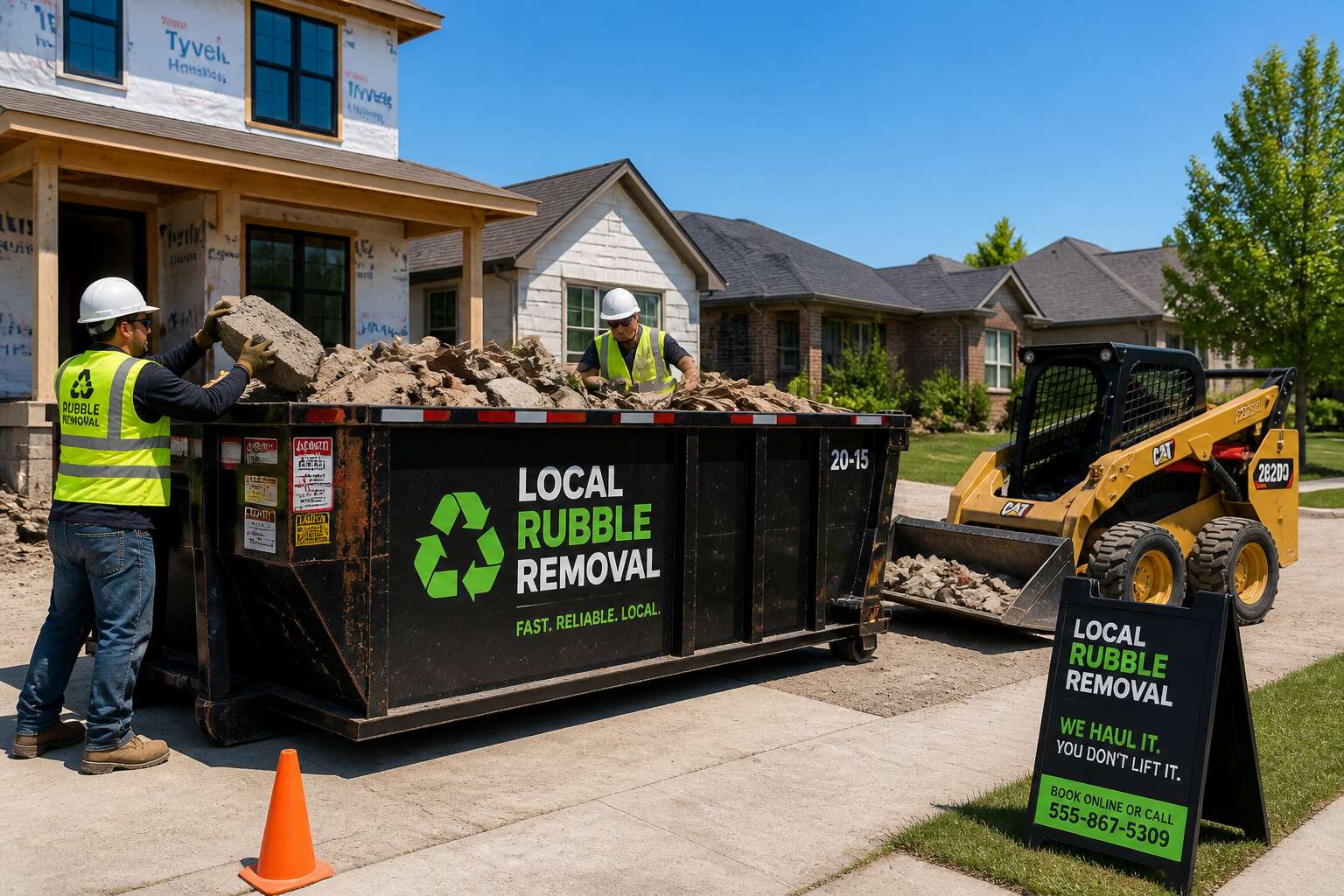
Every renovation produces a distinct mixture of waste, from pulverised brick to fractured tile. Surveying your site before calling for building rubble removal near me is not an exercise in tidiness, it is a practical necessity. The mixture of materials dictates whether the load is inert or hazardous.
- Concrete and masonry fragments
- Timber offcuts and treated wood
- Plasterboard and gypsum waste
- Ceramic tiles and sanitaryware
Each category carries different weight and disposal restrictions. A skip filled with plasterboard behaves differently on the scale than one packed with concrete. Knowing these distinctions allows you to estimate volume accurately and avoid surcharges! In Cape Town, for instance, mixed loads often require scrutiny at landfill sites. Sorting your debris stream beforehand simplifies the entire process.
Estimating Volume and Weight for Disposal Quotes
Every heap of debris tells a story of demolition. To read that story, you need a profile. Identify the ratio of stone to wood, of ceramic to gypsum. This composition directly dictates your weight estimate. For disposal quotes, precision trumps hope.
- List each material type
- Calculate its volume separately
- Apply a standard density factor
That sequence yields a credible figure. When you finally contact building rubble removal near me, your numbers become leverage. I have seen quotes double because a client guessed. Do not guess. Measure the void space between chunks and subtract it. Your debris profile is your map. Follow it and the estimate will follow you.
Sorting Materials That Require Special Handling
Every pile of construction waste carries a hidden signature. The materials you discard speak volumes about the project’s scope and, more importantly, its hazards. Concrete and brick form the heavy backbone, but the true challenge lies in identifying the fragments that demand a different protocol.
Look for the outliers in the mix. Plasterboard, with its paper facing, is often mistaken for inert waste, yet it requires a specific disposal path. Timber coated in lead-based paint, or insulation that has settled and compacted, changes the classification of your entire load.
Common components to identify on site:
– Reinforced concrete and rebar
– Treated timber and laminated beams
– Ceramic tiles and porcelain fixtures
– Asbestos cement sheeting
– Gypsum-based drywall
The presence of asbestos is the critical determinant. It is not always obvious, appearing as a grey, fibrous sheet that can crumble under pressure. Professional building rubble removal near me services will not touch this material without prior notification. They require it to be double-bagged and clearly marked, separate from the general heap.
Sorting these elements at the source transforms your waste from a liability into a manageable asset. By separating the hazardous from the benign, you reduce the risk of contamination and the potential for inflated pricing. A clean, well-segregated pile is simpler to process, which often reflects in the final quote. The effort you put into this initial triage is a direct investment in the efficiency of the entire removal operation. It demonstrates a level of diligence that professionals notice and respect.
Checking Local Regulations for Private Haulers
Identifying your project’s debris profile is the first step toward a smooth clearance. Renovations produce a messy amalgam of materials, each with distinct handling requirements. You might see broken concrete blocks next to timber offcuts and twisted metal rebar. A professional building rubble removal near me service will assess this mix before providing a quote, because weight and composition directly influence pricing structures.
The presence of certain materials changes the entire disposal process. Gypsum-based drywall, for instance, requires separation from general construction waste in many municipal landfills. Similarly, treated timber cannot simply be burned or buried due to chemical preservatives. When you search for building rubble removal near me, you are essentially seeking a partner who understands these nuanced categories and can route each material to the correct facility.
Navigating Local Regulations for Private Haulers
Private haulers operate under strict municipal bylaws that govern waste transportation and dumping. These regulations exist to prevent illegal dumping and ensure that hazardous materials are tracked properly. A legitimate service provider will hold the necessary permits and will typically handle the paperwork involved with permits for larger loads. This compliance is factored into the service cost, so unusually cheap quotes should raise a red flag about where the waste might actually end up.
The logistics of a removal job extend beyond simply loading a truck. Access constraints, such as narrow driveways or low-hanging branches, can affect the equipment used on site. Many companies charge a base rate that covers a specific tonnage, but exceeding that weight limit incurs additional fees. This is why an on-site evaluation is often necessary rather than a phone estimate. The driver needs to see the volume and density of the pile to gauge whether a standard tipper truck or a larger roll-off bin is more appropriate for hauling debris from your property.
Disposal fees fluctuate based on the type of waste and the current landfill tariffs. A responsible company will be transparent about these levies, distinguishing between the labour cost and the dumping cost. When you coordinate with a service that specializes in local logistics, you gain the advantage of their established routes and relationships with waste facilities. This efficiency often results in a faster turnaround, saving you from the burden of multiple trips to the dump yourself. The entire process, from the initial curb-side pickup to the final reconciliation of weights, becomes a streamlined operation handled by professionals.
Evaluating Local Junk Removal Services
Questions to Ask Before Booking a Pickup
Forty percent of Cape Town homeowners admit they never asked about insurance before a load disappeared. That mistake costs more than money when your building rubble removal near me turns into a neighbour’s driveway surprise.
Before booking, ask three essentials. First, confirm the company’s waste disposal licence. Second, request a written quote that includes tipping fees. Third, ask who handles unexpected items like rebar or asbestos.
- Does the price change if the truck is half full?
- Will they sweep the loading area?
Polite but direct inquiries reveal character. A reputable haulier welcomes questions. One who hesitates likely hides costs or shortcuts.
Comparing Flat-Rate vs. Per-Load Pricing
When you search for building rubble removal near me, you’ll encounter two pricing structures. Flat-rate quotes promise simplicity. Per-load pricing offers flexibility. Both have merits, and both have traps.
Flat-rate pricing works well for predictable jobs. A single quotation covers truck, labour, and disposal. You know the cost before the truck arrives. This suits bigger renovations where volume is known. The risk surfaces with ambiguous quotes. Some companies exclude certain materials, or add surcharges for access issues.
Per-load pricing charges based on what you actually dispose of. This benefits smaller jobs where volume varies. You pay for the space your rubble occupies, not an estimate. The danger lies in under-declaring weight. A half-full truck might still carry substantial concrete mass. Hauliers calculate chargeable weight, not just visual volume.
Consider these factors when comparing quotes:
– Trip charges for short hauls
– Weight limits before penalties apply
– Availability of smaller trucks for partial loads
– Handling fees for mixed material streams
Ask the haulier how they measure a load. Do they use a weighbridge, or visual estimation? Visual estimates favour the company, not you. Weighbridge calculations provide transparency.
The most reputable operations publish their rate cards. They explain the difference between a single load and a bundled price. They also clarify what happens with contaminated material. A load with timber, soil, and concrete cannot match a clean concrete load in price.
Here is the practical reality. For a full truck of homogeneous brick and concrete, flat-rate wins. For scattered debris from multiple trade visits, per-load saves money. Your choice depends on how accurately you can predict your waste stream.
The best building rubble removal near me offers both structures. This flexibility signals confidence in their processes. It also demonstrates respect for your budget. A haulier who forces one pricing model may have a reason. Find out what it is before you commit.
Reading Reviews and Verifying Licensing
Reading reviews for building rubble removal near me requires a discerning eye. A five star rating from a homeowner with a single skip bag tells you little about how a company handles a full demolition load. Look for patterns across multiple reviews. Repeated complaints about late arrivals or hidden fees speak louder than any polished testimonial.
Licensing verification matters just as much. In South Africa, a legitimate haulier must hold the necessary permits for transporting waste. Ask for their registration details and confirm them with the relevant authorities. A company that hesitates to share this information is hiding something.
- Check for recent reviews, not just the overall score
- Confirm the company’s physical address exists
- Request proof of insurance before booking
Your time spent vetting a building rubble removal near me service is never wasted! The cheapest quote becomes expensive when your rubble ends up dumped illegally and the fine lands on your doorstep.
Same-Day and Scheduled Collection Availability
According to a 2023 industry poll, nearly 65% of renovation callers demand a same-day pickup for building rubble removal near me. This urgency often clashes with the reality of truck dispatch. I evaluate local junk removal services by their booking window. A firm that promises a fixed time slot without buffer times usually falls short. Look for services that offer a two hour arrival window. They respect your schedule.
Scheduled collections need a different lens. You must verify their cancellation policy for bad weather. A service that charges for a missed slot when you reschedule a week ahead is not flexible. Weigh your tolerance for waiting against the price difference. Same-day options carry a premium. Scheduled slots often cost less. Choose based on your project timeline.
Understanding Disposal and Recycling Costs
Breakdown of Typical Hauling Fees
In Johannesburg, the cost to clear a tonne of mixed rubble often surprises homeowners. A standard hauling fee bundles several discrete charges, each with its own logic. You pay for the truck’s time, the driver’s skill, and the disposal site’s levy.
Typical hauling fees decompose into three parts:
- Transport charge per kilometre or per zone
- Disposal or landfill gate fee, often R200 to R500 per tonne
- Recycling surcharge for concrete or brick that requires crushing
Recycling facilities usually charge less than landfills, yet they inspect loads meticulously. Clean, sorted debris avoids penalties, while contaminated batches inflate your final invoice. The true cost of building rubble removal near me becomes transparent only when you ask for an itemised quote.
How Dumpster Rental Compares to Professional Loading
When a load of rubble leaves your driveway, the cost is more than just the truck showing up. In fact, most companies base their quotes on a combination of variables that many homeowners overlook until the final invoice arrives. You might think a pile of broken bricks is a simple problem, but the price tag often reflects a complex chain of logistics, fuel, and disposal fees that change weekly.
On average, you are paying for a specific journey. The distance from your property to the nearest licensed landfill or recycling plant is the primary driver of your transport cost. If you live in a central suburb versus a remote farm, expect the per-kilometre rate to fluctuate significantly. However, the biggest surprise for many people is the gate fee, which is the charge the dump facility imposes per tonne. This fee covers the operational costs of managing hazardous materials and general waste. Because this rate is set by the municipality or private facility owner, it changes frequently and is largely outside the control of the removal company.
Here are the core elements that influence your final price:
– Distance to the disposal site: Longer hauls mean higher fuel costs and more driver hours.
– Weight of the load: Heavier materials like concrete and tiles are priced higher per tonne.
– Labour intensity: If we must carry the debris up three flights of stairs or navigate a narrow passage, additional time is factored in.
– Disposal type: Construction waste often has a different tariff than mixed household rubbish.
But there is a hidden layer to this process that can save you money. Most reputable services will sort your rubble on-site to separate clean concrete from contaminated mixed waste. This is not just an environmental courtesy; it is a financial strategy. Clean, inert material can be crushed and repurposed as aggregate, which means it attracts a much lower disposal tariff than mixed garbage that requires sorting at the plant.
My advice is to always ask for a breakdown of the “dump fees” versus the “labour fees” when you search for building rubble removal near me. A quote that looks cheap on paper might be excluding the tonnage fee, which is added at the weighbridge. Conversely, a slightly higher upfront quote often includes everything, offering peace of mind and preventing awkward surprises when the driver hands you the scale ticket. By understanding these mechanics, you can budget accurately and possibly save enough to cover the cost of a cold drink on your next renovation day.
Additional Charges for Heavy or Hazardous Waste
The final invoice for building rubble removal near me often carries a sting that has nothing to do with the physical weight of the debris. You might anticipate the labour and the truck, but the disposal side of the equation is where the arithmetic gets murky. Many homeowners are surprised to learn that the cost of getting rid of the material is frequently higher than the cost of moving it. This is largely because the landfill or recycling facility charges a “gate fee” based on the tonnage, and that fee is passed directly on to you.
This becomes particularly relevant when you are dealing with mixed loads. If you have a pile of broken tiles, old bricks, and subsoil all jumbled together, it is classified as mixed waste. This classification attracts a higher tariff than clean, sorted loads of concrete or brick. The facility must process and sort this material, which requires additional machinery and labour. As such, the disposal cost escalates quickly. For those searching for efficient solutions, the distinction between a clean load and a contaminated one is the single biggest variable in the final price.
Sometimes, a list is the clearest way to understand the potential surcharges that go beyond the basic per-tonne rate:
– Contaminated soil: If your rubble contains clay or soil mixed with concrete, it often cannot be recycled and carries a higher dumping fee.
– Asbestos or hazardous materials: These require special handling, separate transport, and dedicated landfill sites, all of which add significant cost.
– Oversized items: Large concrete slabs or tree stumps may require crushing on-site before they can be transported, adding a processing fee to your bill.
To avoid these nasty surprises, the smartest move is to ask for a quote that includes the disposal vouchers. When you request a price for building rubble removal near me, a reputable company will provide a figure that covers the skip hire, the transport, and the landfill charges. You should be wary of any quote that seems exceptionally low, as it likely excludes the gate fee. The worst scenario is receiving a call from the driver saying your load has been rejected because it contains a material that requires a higher fee. This breaks the budget and the schedule, so a conversation upfront about what exactly is in the pile is always worth having.
Ultimately, the fee is not just a tax; it is the cost of ensuring that old concrete becomes new aggregate and that hazardous waste does not end up in a river. Paying the proper rate means you are contributing to a system that handles these materials safely. So, when evaluating your options, focus less on the sticker price and more on the total cost of compliance. A fair price for proper disposal is a bargain when compared to the hefty fines for illegal dumping, and it gives you the quiet satisfaction of knowing your renovation waste is being handled responsibly.
Ways to Get Accurate Quotes With Photos and Measurements
Let’s be honest about the moment your renovation project hits its financial reality. You have budgeted for the new countertops and the fancy tiles, but the pile of broken concrete and old plumbing sitting in your driveway is a surprise line item. The genuine cost of any demolition is not the hammer swing; it is the disposal. When you start searching for building rubble removal near me, the price you see quoted is rarely the price you end up paying.
The gap between the estimate and the final invoice usually comes down to one sneaky factor: the tipping fee. This is the charge the local landfill or recycling plant hits the removal company with for accepting your waste. A professional crew has to pass that cost onto you, which is fair. The problem is that many customers only hear about the truck and the labour, not the per-tonne cost of dropping the load. This is where your homework pays off. A company that provides a flat, all-inclusive rate is a rare find, but asking for that clarity upfront will save you from a sour surprise.
You can protect your wallet with a little preparation before the crew arrives. The secret is to make their job as easy as possible, because an easy job often translates to a lower bill.
– Separate the heavy stuff: Keep concrete, bricks, and tiles in one pile. Keep wood, plasterboard, and general junk in another. Mixed loads often get charged at a higher rate because they require extra sorting at the facility.
– Know your weight limit: A standard 6-yard skip holds roughly two to three tonnes of rubble. If you are hauling old concrete slabs, you might hit the weight limit before the skip is full. Ask about overage charges.
– Get a written quote: A price quoted over the phone without a site visit is a gamble. Always ask for a firm, written estimate that specifically states the disposal costs are included.
When you finally get a quote for building rubble removal near me, do not just look at the bottom line. Ask the provider if the price includes the landfill charges. If they hesitate or start talking about “potential fuel surcharges” and “weight variables,” you are likely dealing with a company that will pad the invoice later. The right provider will give you a single, honest number and stick to it. That is the peace of mind that makes the dust and the noise worth it. So, before you pick up the phone, get your piles sorted and your questions ready. The best quote is the one you never have to question again.
Navigating Permit and Drop-Off Requirements
Local Transfer Station Rules for Construction Debris
Local transfer stations rarely accept construction debris without prior approval. You may need a waste manifest, a disposal permit, or both. I have seen small contractors turned away for missing the right documentation.
Drop off rules differ across municipalities. Some stations impose daily tonnage caps, while others require separating bricks, concrete, and treated timber. A simple checklist prevents wasted trips:
- Verify the station’s accepted waste list
- Bring proof of residence or company registration
- Ask about exclusion of asbestos or other hazardous items
When you search for building rubble removal near me, confirm whether the hauler manages these permits. Professional services often coordinate with the transfer station directly, saving you the administrative headache.
When a Permit Is Needed for a Dumpster on Your Driveway
A single missed permit can turn a straightforward renovation into a costly standstill. Municipalities often enforce strict rules about skip placement, and many homeowners discover this only after receiving a fine. Navigating these requirements takes preparation, especially when your timeline depends on a clear site for delivery.
The first step is to call your local council. You need to know if a permit applies to your street, and whether the drop-off point requires special approval for public land. Some areas have blanket restrictions during peak hours, while others demand specific signage or safety barriers around the skip.
Once you have the green light, organise your waste accordingly.
– Confirm the skip size against your council’s maximum allowable volume.
– Check if the permit fee is included in your rental quote or charged separately.
– Arrange for the skip to sit on private property, such as a driveway, to avoid road closure applications.
– Clarify load limits, since overweight skips can lead to additional charges or refusal at the tip.
You should also confirm whether your chosen provider handles the permit application. Many full-service companies manage this paperwork as part of their standard offering. If they do, request written confirmation of the approval before the delivery date. If not, factor the extra time into your project schedule.
Dealing with drop-off rules at the landfill follows a similar logic. Some facilities only take rubble from registered vehicles, and proof of residence may be required. A reputable building rubble removal near me service will know these site-specific protocols and can ensure your load meets the accepted criteria.
Ultimately, the goal is a seamless transfer from your property to the disposal facility. A provider who handles permits and understands local ordinances saves you from unexpected halts. Ask direct questions about their process, and make sure every requirement is documented before the truck arrives. That clarity keeps your project moving and your budget intact.
Proper Documentation for Asphalt, Concrete, and Brick
Asphalt, concrete, and brick demand more than muscle to move. These heavy materials require a paper trail from the moment the truck pulls away until the load reaches the scale at the landfill. Missing documentation for your building rubble removal near me job can hold your load at the gate, turning a quick run into a costly waiting game.
Load tickets serve as your proof of responsible disposal. Reputable transfer stations issue these certificates after weighing and inspecting the debris, confirming that the materials meet site acceptance rules. Without that ticket, you have no record of compliance. Keep it somewhere safe, as councils may request this proof if they question how you cleared your property.
Check your ticket carefully before you leave the facility:
– Confirm the gross, tare, and net weights are accurate
– Verify the date and the vehicle registration match your details
– Check that the material description lists asphalt, concrete, or brick correctly
– Keep the ticket for at least six months in case of disputes
Clean loads of concrete or brick often have simpler requirements, but asphalt carries its own regulations. Some facilities separate asphalt for recycling and may charge a different rate. Contaminated loads, such as rubble mixed with wood or plasterboard, might face rejection altogether. A reliable building rubble removal near me service understands these distinctions and ensures your load arrives clean, sorted, and documented. This attention to detail keeps your project on schedule and your paperwork in order, so the haul runs smoothly from kerb to final disposal.
Avoiding Illegal Dumping Penalties
Forty percent of fly-tipping incidents in South Africa involve construction waste, a statistic that should give any homeowner pause. The path from your driveway to a compliant disposal site is rarely straight, and shortcuts carry consequences that far outweigh the cost of a legitimate haul.
Before a single brick moves, you must understand your local municipality’s rules. The city of Cape Town, for instance, strictly controls where builders’ rubble may be deposited. A building rubble removal near me service worth its salt will have pre-arranged access to licensed facilities, sparing you the bureaucratic headache of sourcing the correct permits yourself. Some suburbs require a drop-off permit for certain vehicle types, so confirm this detail before the loading begins.
The difference between a professional operation and a cowboy outfit becomes glaringly obvious at the disposal gate. The wrong hauler might offer a “special” rate and then dump your debris on a vacant plot in the middle of the night. You remain liable for that mess, even if you never touched the waste after it left your property. The penalties for illegal dumping in South Africa are substantial, with fines that can reach R100,000 or even imprisonment. Your reputation and your wallet are on the line.
– Confirm the hauler’s waste disposal licence is current and valid
– Ask for the physical address of the drop-off site before they leave
– Request a trip ticket number or weighbridge slip for your records
– Verify that your suburb permits rubble collection on the day you’ve booked
A trustworthy service will tell you upfront which facilities accept your particular mix of materials. That clarity prevents a turnaway at the gate serious time wasted. The modest cost of responsible removal is an insurance premium against a legal entanglement you do not want.
Sustainable Rubble Removal and Recycling Practices
Salvaging Reusable Bricks and Concrete Pieces
South African landfills receive a heavy load of construction waste, yet many bricks and concrete pieces keep their structural value. When you search for building rubble removal near me, sustainable operators sort these materials on site before hauling. Clean clay bricks can be reused in heritage walls or garden paths, and crushed concrete works as aggregate for new foundations or road base.
The task demands manual sorting and a hammer to knock off old mortar. A good service stacks salvaged items on pallets and weighs the remaining debris accurately, cutting disposal costs because less reaches the tip. I have watched contractors recover thirty percent of a load.
- Whole bricks for masonry reuse
- Concrete chunks for sub-base
- Stone pieces for landscaping
This turns a removal job into resource recovery, keeping valuable material in circulation.
Finding Facilities That Process Crushed Aggregate
South Africa’s construction sector sends millions of tons of rubble to landfill each year, yet a significant portion can be crushed and reused. The real challenge is finding facilities that process crushed aggregate properly.
When you search for building rubble removal near me, ask where the load will actually go. Responsible operators work with plants that screen out rebar and contaminants, then crush concrete and bricks into graded aggregate for road base or new foundations.
These facilities may offer:
– Crushed aggregate for bulk purchase
– Recycled sub-base for construction projects
– Documentation for environmental compliance
That transparency separates genuine recyclers from haulers who simply offload at the tip. Sustainable practices depend on this kind of accountability.
Responsible Disposal of Plaster, Drywall, and Tiles
Plaster, drywall, and tiles form a silent burden in renovation waste. These materials behave differently from concrete or brick, yet many homeowners treat them as one homogeneous pile. Gypsum-based products release sulphides when buried in wet landfill conditions, which then leach into groundwater. Ceramic tiles, meanwhile, often contain silica dust that can become airborne during crushing. The question of what happens to these specific components matters when you search for building rubble removal near me. A responsible service must separate these from the aggregate stream entirely.
A meaningful disposal strategy depends on knowing how the operator handles mixed debris from your site. Ask for their end destination logic. A service that claims to process everything equally is hiding a fundamental disturbance in the chain.
Responsible removal operators will:
– Segregate plaster and drywall loads for dedicated gypsum recovery
– Redirect uncontaminated tiles to aggregate crushing lines
– Divert damaged ceramics to licensed construction fill sites
The line between lawful disposal and environmental negligence lives in these practices, not in advertising.
Reducing Landfill Waste Through Donation and Reuse
Rubble removal after a renovation feels like a final act of forgetting, a chance to bundle the past into a skip and move on. Yet the true measure of a service is not how quickly the truck disappears, but where the load eventually lands. The honest operators have elevated recycling from a polite gesture into a serious engineering practice.
The fate of your broken concrete and twisted rebar can take two distinct paths. One leads to the landfill, where the material becomes a permanent fixture in the local geology. The other leads to a crushing facility where it returns to the economy as aggregate for new projects. A responsible provider will always choose the latter.
Most demolition debris contains a surprising amount of recoverable material. Old timber beams, vintage bricks, and pristine sanitaryware often possess a second life in architectural salvage yards. The discerning client will ask their removal team about these possibilities before the load departs.
A competent service will structure its collection around the end product, not just the immediate sale of the load. Consider the difference between a company that merely hauls and one that diverts:
The recycling infrastructure exists. It demands a provider who treats your debris as a resource stream rather than refuse. The search for building rubble removal near me should reward those who bring their own environmental conscience to the job, not simply the lowest quote.
In South Africa, where landfill airspace grows scarcer each year, this distinction carries real economic weight. The landfill gate fee rises with the volume of waste processed, and that cost eventually reflects in the bid you receive. A facility that charges less by skipping proper separation leaves the difference in the ground. Choosing a service that embraces the circular economy is a quiet act of good citizenship, performed long after the dust has settled.
Preparing Your Site for Efficient Debris Collection
Clearing Access Paths for Heavy Bags and Wheelbarrows
As you arrange a building rubble removal near me, the condition of your site determines how efficiently the crew can operate. A debris pile tucked behind a garden wall or wedged against a doorway forces manual double handling, which stretches the scheduled time and affects the final quote.
Clear a corridor at least a metre wide from the rubble stack to the collection point. Most delays happen here, because homeowners rarely account for the turning arc of a fully loaded wheelbarrow or the space needed to swing a heavy bag between two carriers. The ground should be level where practical, with loose nails, offcuts, and shattered tile swept aside before the arrival window.
That cleared route also protects the workers themselves. A single nail buried in plaster dust can pierce a boot sole, and a shifting plank can twist a knee under a thirty kilogram load. A prepared path lets the team focus on the removal itself rather than improvising a route through clutter.
Protecting Flooring and Landscaping During Loading
A surprising number of damaged driveways and crushed garden beds result not from the original renovation work, but from the loading process itself. The true enemy is often the static weight of a fully laden skip bag resting on a single spot, compounded by the shear force of a wheelbarrow’s turning arc. When you arrange a building rubble removal near me, the crew’s primary focus is on protecting your surfaces, yet they rely on you to provide the staging ground.
Lay down thick plywood sheets or rubber track mats across the designated unloading traffic zone. This distributes the pressure across a wider footprint, preventing cracks in paving and ruts in the lawn. The team will likely use a two-person carry for heavy bags, which creates a concentrated load on their boot heels. A simple layer of protective material can prevent the impression of a concrete block being permanently stamped into your turf.
Consider the proximity of your water features and irrigation systems. A parked truck can block a sprinkler line, but the more insidious risk is the acidic leachate from wet plaster or cement dust that can burn grass roots. Position the collection point away from delicate flower beds. Furthermore, ensure that any fragile paving, such as clay pavers or slate tiles, has a clear visual marker like a traffic cone placed at the edge, so the team does not mistake it for a solid entry point. A little preparation ensures the only remnant of the project is the clean, open space you paid for.
Grouping Rubble by Type to Speed Up the Crew
Before any rubble leaves your property, the way it sits in a pile determines how fast the job goes. A jumbled mass of brick, concrete, and timber forces the crew to dig, sort, and shift each piece by hand, draining hours from the day. Take the time to group materials into distinct stacks, and you hand the team a clean canvas to work from.
Start with the heavy stuff. Concrete and brick should sit together, since most facilities crush them into aggregate for reuse. Tiles, porcelain, and ceramics form a separate category, as do plasterboard and timber, which often require individual handling. Avoid mixing metal pipes or wiring into the general pile; a quick separation keeps these valuable scraps from being buried under debris.
Here is a practical breakdown for your staging area:
- Concrete, brick, and blockwork in one corner
- Timber, joists, and plywood in another
- Metal, including rebar and copper piping, set aside
- Plasterboard and gypsum kept dry and separate
- Mixed general waste in a marked skip
The crew that arrives for building rubble removal near me will thank you for the order. A tidy site speeds up loading, cuts down on double handling, and often lowers the final bill, since clean loads process faster at the transfer station. Keep the paths clear between stacks, and watch the whole operation run smoother than a shovel through sand.
Coordinating With the Hauling Team on Arrival Day
Arrival day starts long before the truck appears. A site that is ready to load saves minutes on the clock, especially when you have booked building rubble removal near me and the crew is working around school traffic and load shedding schedules.
Take a final walk around your property the evening before. Move vehicles off the driveway, unlock gates, and confirm the parking spot is level and solid. If the ground is soft, lay down plywood sheets so the truck does not sink in. Check that the gate opening matches the truck’s width, since a tight entrance eats time on the day itself.
- Confirm the arrival window with your hauler
- Mark any underground pipes or sprinkler heads
- Keep pets indoors and children away from the work zone
When the team arrives, do a quick walkthrough together. Point out the dense concrete, the timber stack, and anything fragile underneath. Agree on the loading order before the first bag is lifted. This conversation prevents reroutes and reloads, and it turns a busy morning into a coordinated effort.


0 Comments